The 10 Major Differences Between poWermap, LinkedIn, Xing and Other Professional Social Networks
Discover how poWermap redefines professional networking for the multi-identity and fractional economy. Unlike traditional platforms built around a single, static profile (like LinkedIn or Xing), poWermap offers a powerful mobile-first experience designed for modern professionals who juggle multiple roles, projects, and businesses simultaneously.
Useful tips
LinkedIn and Xing have long defined how professionals build careers, recruit, and manage their contact networks. However, the modern professional landscape has drastically changed: professionals no longer have just one career track—they juggle multiple projects, advisory roles, freelancing, and businesses simultaneously.
poWermap is built for this emerging multi-identity and relationship-driven economy. Here are the 10 major differences that set poWermap apart from traditional professional social networks.
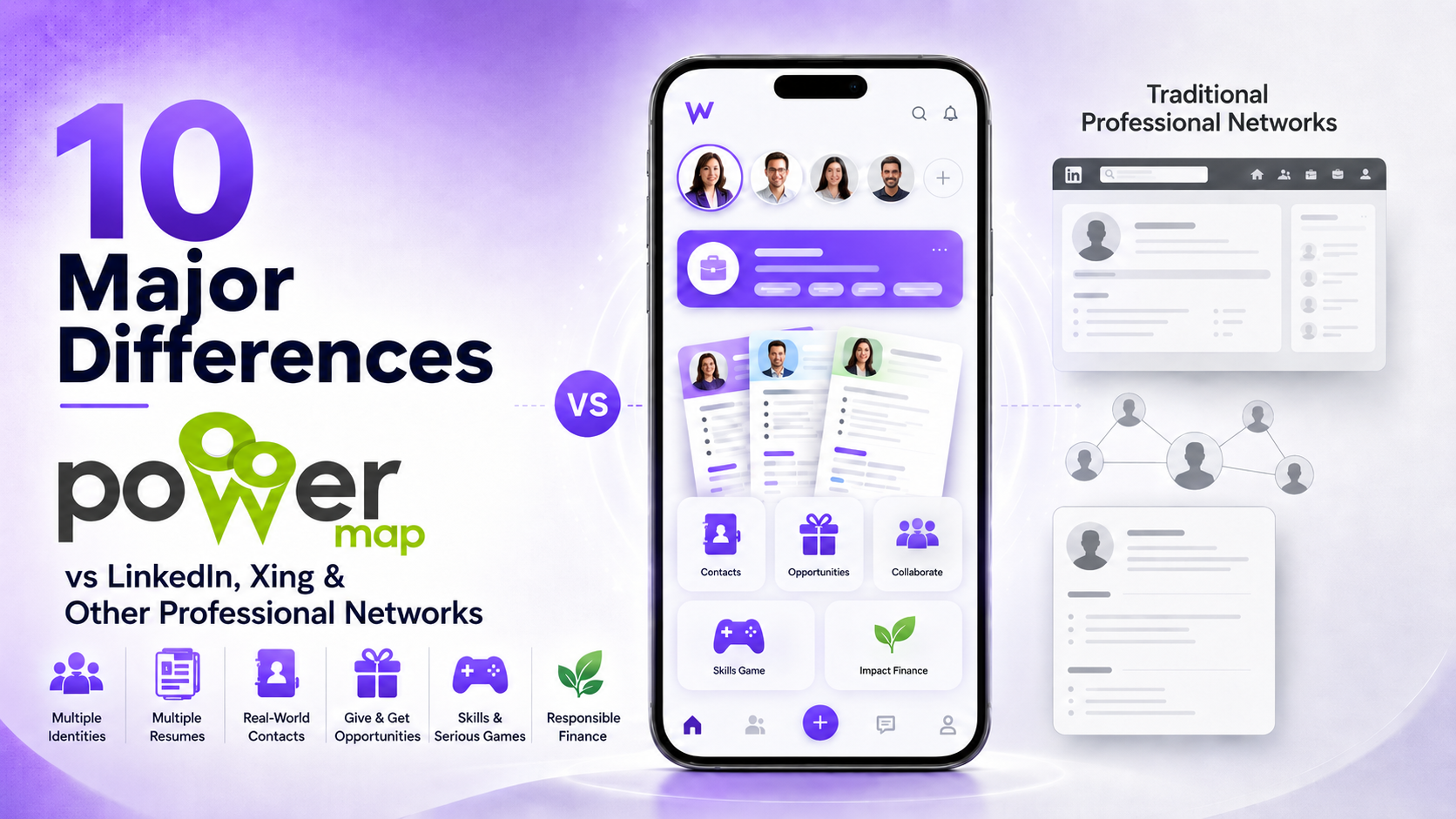
Here are the 10 major differences between poWermap and traditional professional social networks such as LinkedIn, Xing and others.
Power Map Contacts · iOS & Android
```
Build your multi-identity network
Organize your contacts, profiles, and personal brand in one app built for the new multi-identity economy.
poWermap vs. Traditional Professional Social Networks at a Glance
Area
poWermap
LinkedIn, Xing & Traditional Professional Networks
Business model
Subscription-first
Primarily free-entry / freemium
Professional identities
Multiple profiles from one account
Mainly centered around one personal professional profile
Resume management
Multiple resumes per profile
Resume is not the central profile-management model
B2C experience
Mobile-first / 100% mobile strategy
Web + mobile
Real-world contacts
Phone address book plays a central role
Platform social graph plays the central role
Product governance
Collaborative community approach
Platform-led product decisions
Responsible finance
Integrated into the roadmap
Not a core professional-networking feature
Professional data
Designed to become an asset for the user
Primarily used to power the platform and professional network
Serious games
Used to enrich professional data
Gamification is generally secondary
Gifts & relationships
Gifting is designed as a relationship-building mechanism
Likes, reactions and messages are the dominant interactions
1. Multiple Profiles From One Single Account vs. One Monolithic Profile
LinkedIn / Xing: Historically centered around a single, linear personal professional profile per account. Juggling multiple professional activities often forces users to compromise or create awkward workarounds.
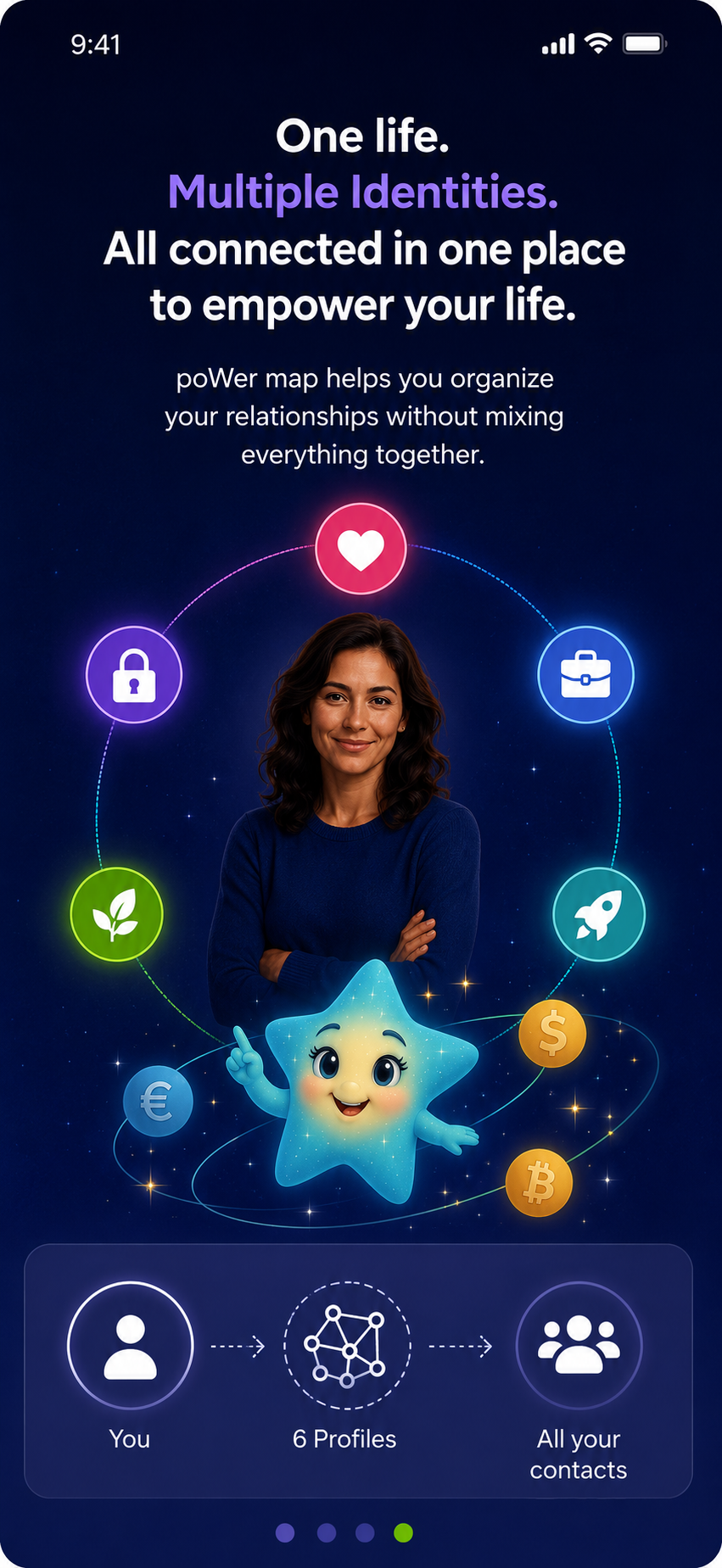
poWermap: Allows you to create up to 6 distinct personal or professional profiles from a single account. Whether you are a founder, advisor, investor, or association member, you can instantly switch between your active roles (with color-coded indicators for personal vs. professional).
📲 Prêt à unifier vos casquettes professionnelles ? Ne multipliez plus les outils : regroupez toutes vos identités dans votre poche.
Power Map Contacts · iOS & Android
```
Build your multi-identity network
Organize your contacts, profiles, and personal brand in one app built for the new multi-identity economy.
2. Real-World Address Book Integration vs. Pure Virtual Networking
LinkedIn / Xing: Focus primarily on in-network platform connections, often turning networking into an endless stream of digital broadcasting.
poWermap: Elevates your phone’s native contact book to give it the importance it deserves. Your real-world network—people you've met at networking events, called, or worked with—is seamlessly organized alongside your digital interactions.
Traditional Networks: Provide a flat list of connections where relationships quickly get lost or forgotten.
poWermap: Introduces smart relationship management. You can easily distinguish between "Mapped" contacts (associating a contact to one or several specific profiles) and "Connected" contacts (where you and your contacts are mutually linked via active profiles).
4. Mobile-First & Pocket-Ready Experience vs. Desktop-Centric Heritage
Traditional Networks: Built initially around desktop experiences, making quick mobile updates or on-the-go networking clunky.
poWermap: Designed from the ground up as a mobile-first application. Your professional identity, contact book, and messaging hub live natively in your pocket, ready the exact second you meet someone new.
Available on iOS & Android
```
Turn your network into personal capital
With our mobile app Power Map Contacts, organize your contacts, profiles, and identities in one app built for the multi-identity world.
Create personal, professional, or private profiles. Map your network. Take control of your personal brand.
Your network is more than a contact list. It’s a personal asset.
```
5. Relationship Economy vs. Attention / Creator Economy
LinkedIn / Xing: Heavily incentivize public posting, algorithmic reach, and becoming a professional content creator to gain visibility.
poWermap: Focuses on privacy, intentional networking, and real utility. You can benefit from a powerful professional network without being forced to become a content creator.
6. Dynamic Career & CV Management vs. Static Profiles
Traditional Networks: Act as a digital resume locked in a web page format that is tedious to update.
poWermap: Integrates dynamic professional timelines, projects, and structured experiences directly into an interactive format that evolves alongside your career.
7. Gamified Networking & Engagement vs. Passive Scrolling
Traditional Networks: Encourage endless, passive feeds that consume time without driving tangible relationship value.
poWermap: Integrates engaging elements like mini-games designed to help you interact with, enrich, and keep your contact information effortlessly up to date.
8. Direct Peer-to-Peer Value Exchange ("Gifts") vs. Paywalled InMail
Traditional Networks: Often lock direct outreach and messaging behind expensive premium tiers (InMail credits).
poWermap: Prioritizes meaningful value exchanges—sharing insights, opportunities, or useful introductions—fostering genuine relationship-building over transaction gates.
9. Privacy-Controlled Compartmentalization vs. Over-Exposed Feeds
LinkedIn / Xing: Your professional network, colleagues, clients, and personal acquaintances often mix in a single opaque feed.
poWermap: Allows you to progressively compartmentalize your professional lives while maintaining strict control over how each identity is presented to the world.
10. Built for the Modern Fractional & Multi-Identity Era
Traditional Networks: Rigidly assume you belong to one company at a time.
poWermap: Tailored specifically for the modern fractional economy—where professionals simultaneously wear multiple hats across different industries and ecosystems.
Conclusion: Take Control of Your Capital Relationnel
Traditional professional networks helped digitalize careers, but the next generation of networking requires agility, multi-identity management, and true mobile convenience. Stop losing valuable contacts and start transforming your network into a true personal asset.
Download poWermap Today
Experience the future of Identity Relationship Management (IRM) directly on your smartphone.
Ready to take control of your network?
```
Your contacts are more than names in a phone.
Power Map Contacts helps you organize your profiles, separate your identities, and turn your network into a real personal asset.


.jpeg)
.jpeg)