
September 4, 2026
Discover the 10 best professional social networks in 2026, from LinkedIn and poWermap to GitHub, Behance, Wellfound and more. Compare their strengths for B2C and B2B use cases, and see how poWermap brings a new approach to professional networking through relationship intelligence, multiple identities, CVs, credentials and professional assets.
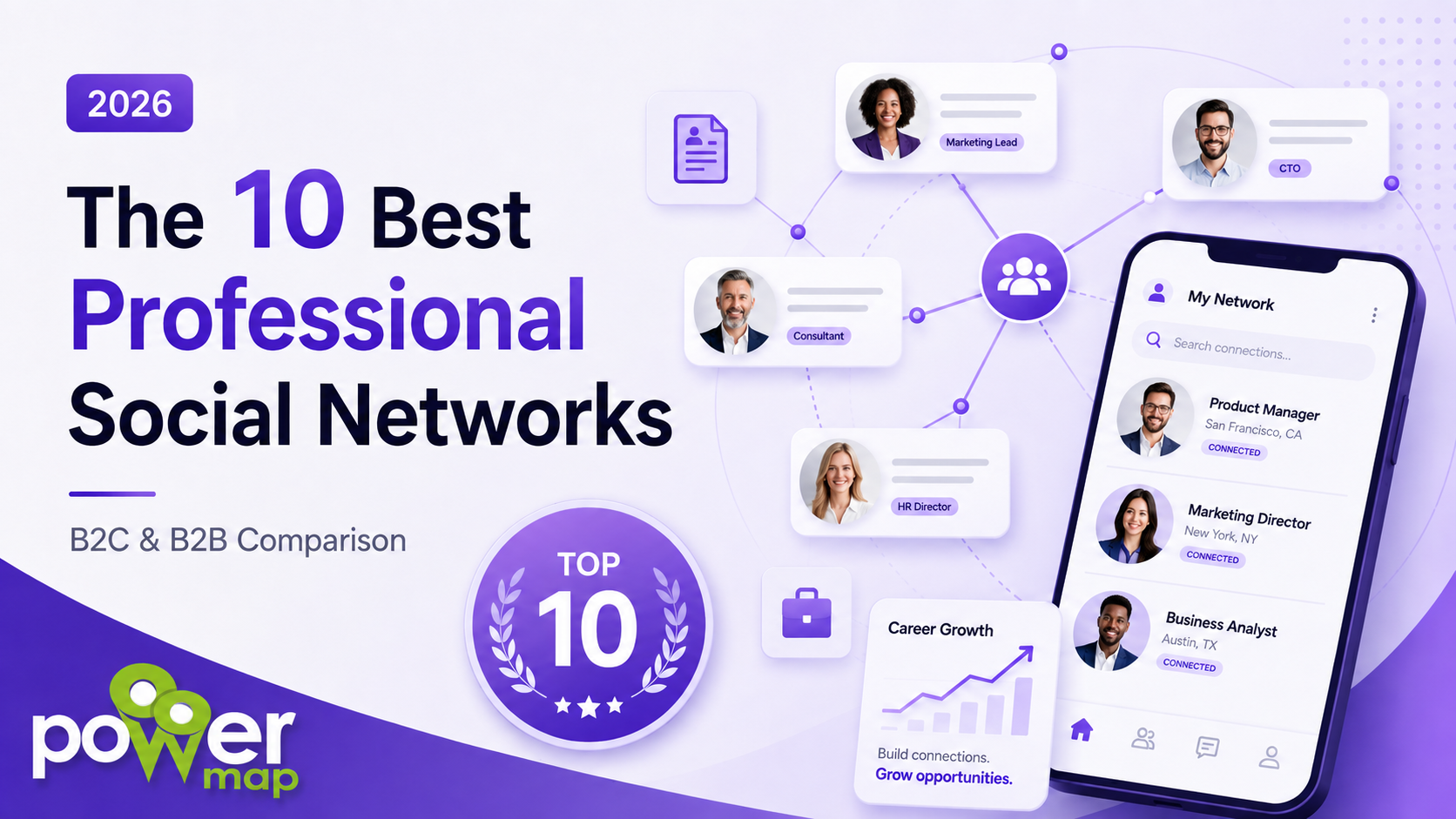
Professional networking is changing.
For more than two decades, the idea of a professional social network was relatively simple: create a profile, connect with colleagues, publish content, follow companies and look for jobs.
LinkedIn became the dominant platform for this model.
But professional life in 2026 is becoming far more fragmented.
A single person may simultaneously be an employee, freelancer, consultant, founder, investor, content creator, advisor, teacher or community member. Our professional identity is no longer represented by one job title, one company or even one public profile.
At the same time, professionals increasingly need different platforms for different purposes:
The result is a new generation of professional networks.
Some focus on reach. Others focus on communities, projects, portfolios, expertise, jobs or relationships.
In this guide, we compare 10 of the best professional social networks in 2026, for both individual professionals and businesses.
For the purposes of this comparison:
B2C refers to the value the platform provides to individual professionals, freelancers, students, executives and job seekers.
B2B refers to the value it provides to companies, recruiters, consulting firms, sales teams, agencies and other organizations.
Organize your contacts, profiles, and personal brand in one app built for the new multi-identity economy.

The right platform therefore depends on what you want your professional network to accomplish.
LinkedIn remains the reference point for professional networking worldwide.
Its core proposition combines several functions that were previously separated: professional profiles, networking, publishing, company pages, recruitment, job search, events, groups, advertising, sales prospecting and professional learning.
LinkedIn describes itself as the world's largest professional network, and its geographical reach remains unmatched. Its official statistics show hundreds of millions of users across Asia-Pacific, Europe, the Middle East, Africa and the Americas.
For individuals, LinkedIn is particularly useful for:
LinkedIn itself describes professional networks as relationships with people users know and trust professionally, while its platform supports connections, followers, groups, events and content.
For businesses, LinkedIn is even more powerful.
Recruiters can identify candidates. Sales teams can discover prospects. Companies can publish content and employment opportunities. Marketing teams can reach highly segmented professional audiences.
LinkedIn's biggest advantage is network density.
If you are looking for someone in a company, industry or profession, there is a good chance that person has a LinkedIn profile.
This makes LinkedIn extraordinarily effective for professional discovery.
LinkedIn primarily manages your public professional presence.
It is less suited to managing the private intelligence behind your network:
Who are your most trusted contacts?
Which relationships belong to which professional identity?
Who introduced you to whom?
Which client relationships are strategically important?
Which CV, credential or project reference should you use for a particular opportunity?
Your LinkedIn network can contain thousands of people without necessarily helping you manage those relationships as professional assets.
Best for: almost every professional who needs visibility, recruitment, prospecting or professional content distribution.
poWermap approaches professional networking from a different direction.
Instead of starting with a public feed and asking:
“How many people can see me?”
poWermap starts with another question:
“How valuable are the people, skills, experiences, credentials and relationships already around me?”
poWermap describes itself as a relationship intelligence and personal asset management platform designed to help professionals and organizations manage contacts, profiles, resumes, credentials, skills, project references and business development information.
This distinction is important.
Traditional professional social networks primarily help users build audiences and discover people.
poWermap aims to help users structure, preserve and activate relationship capital.
Modern careers are becoming increasingly multi-dimensional.
A professional can simultaneously be:
Yet most professional networks still organize a person around one central public profile.
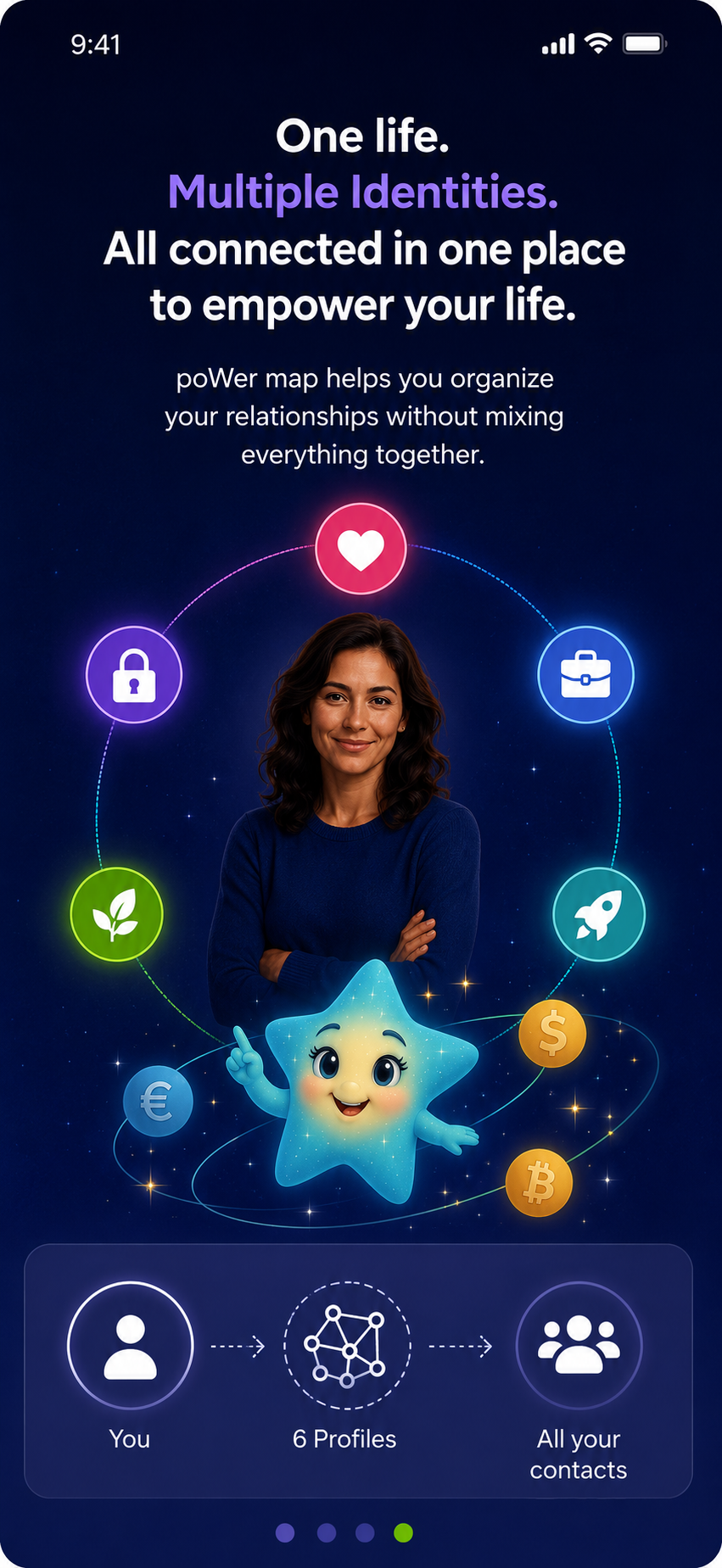
poWermap Contacts allows users to create multiple profiles and separate personal and professional networks, giving users more control over how different parts of their identity interact.
This makes poWermap particularly relevant for fractional executives, consultants, freelancers, entrepreneurs, creators and portfolio-career professionals.
A phone address book remembers a person's name and phone number.
A traditional social network remembers that two people are connected.
poWermap is designed to add another layer: context.
Contacts can be connected with profiles, relationships, business history, skills, opportunities and other professional information.
The objective is therefore not simply to accumulate contacts.
It is to understand them.
This is especially powerful because a professional's best opportunity may already exist somewhere inside their existing network.
Another major difference between poWermap and most professional social networks is the integration of human-capital information.
poWermap brings together elements such as:
This is particularly relevant in consulting, freelancing and professional services, where selling a company often means selling the experience of its people.
A consulting firm's network, CV library, project references and credentials are therefore not simply administrative information.
They are commercial assets.
LinkedIn can help a consulting company identify a prospect.
poWermap is designed to help it answer the next questions:
Who already knows that prospect?
Which consultant has the right expertise?
Which project reference should be presented?
Which CV or credential should be included in the proposal?
Which relationships could provide a warm introduction?
The platform is positioned around the information professional-service organizations use to develop business: people, skills, resumes, projects, contacts, credentials and relationship history.
poWermap also supports privacy-conscious workflows including professional-information anonymization, which can be particularly useful when CVs and credentials are shared during recruitment or business development processes.
The difference can be summarized simply:
This does not necessarily make poWermap a replacement for LinkedIn.
In many cases, the two platforms can be complementary.
LinkedIn can help you discover the professional world.
poWermap can help you organize your own professional world.
That difference may become increasingly important as professional careers move toward multiple jobs, multiple activities, multiple communities and multiple digital identities.
Best for: consultants, fractional executives, freelancers, entrepreneurs, sales professionals, recruiters, creators, managers and professional-service organizations that consider relationships and expertise strategic assets.
With our mobile app Power Map Contacts, organize your contacts, profiles, and identities in one app built for the multi-identity world.
Create personal, professional, or private profiles. Map your network. Take control of your personal brand.
XING has historically been one of Europe's most important professional networks.
Its current positioning has become considerably more employment-oriented.
The platform describes itself today as “The jobs network” and emphasizes professional profiles, job matching, recruiters, career information and employment opportunities. It currently advertises more than one million jobs, hundreds of thousands of employers and thousands of recruiters.
Its strongest markets remain Germany and the broader German-speaking DACH region.
XING can be useful for:
XING offers particular value to organizations recruiting in:
Its weakness compared with LinkedIn is geographical.
If your professional ambitions are global, LinkedIn generally offers a much broader network.
If your career is centered on the DACH economy, however, XING remains highly relevant.
Best for: professionals, recruiters and employers operating in German-speaking Europe.
Formerly known as AngelList Talent, Wellfound has become one of the most specialized platforms connecting startup companies and professionals.
The platform states that more than 27,000 startups are hiring and promotes access to a large startup-oriented candidate ecosystem.
Wellfound is less about building a mass professional audience than connecting the right talent with the right startup.
Wellfound is particularly useful for professionals interested in:
The B2B proposition is extremely strong.
Startups can advertise jobs, search for talent and use recruiting tools to identify candidates.
This focus can produce better relevance than a generic professional network when the objective is specifically startup recruitment.
Wellfound is a specialized ecosystem.
It is not designed to manage an entire professional identity, relationship network or business-development ecosystem.
Best for: startup founders, startup employees, technology professionals and recruiters.
Contra represents another evolution of professional networking: the convergence of professional profile, portfolio, community, project discovery and freelance work.
In 2026, Contra describes itself as “the network for creative intelligence.” Its ecosystem showcases creators, developers, designers, studios, projects and professional communities while helping independents get discovered and paid.
Contra is especially relevant to:
Traditional networks show what job you have.
Contra is better suited to showing what you can actually produce.
Projects and portfolios become central elements of professional identity.
This makes the platform particularly attractive in a labor market increasingly organized around missions, projects and specialized expertise rather than permanent employment alone.
Companies can search for specialists and creative talent directly.
This gives Contra a strong B2B talent-discovery dimension.
Its limitation is that it is far more relevant to independent and creative work than to many traditional corporate professions.
Best for: freelancers, creators, independent professionals, creative studios and companies hiring project-based expertise.
GitHub is technically a software development platform.
In practice, it has also become one of the most important professional identity platforms for developers.
GitHub reports hundreds of millions of developers, millions of organizations and hundreds of millions of repositories on its platform.
For a software engineer, a GitHub profile can sometimes communicate more professional information than a traditional resume.
Why?
Because it can demonstrate actual work.
Recruiters and collaborators can potentially see:
This is GitHub's major professional-networking advantage.
A traditional resume says:
“I know this technology.”
GitHub can provide evidence that you have actually used it.
The platform also enables collaboration between developers and organizations around the world.
For technology companies, GitHub is not simply a recruitment network.
It is part of the production infrastructure itself.
Organizations can collaborate with developers, manage projects and identify open-source talent.
Its limitation is obvious: GitHub is highly specialized.
Best for: developers, software engineers, open-source contributors and technology companies.
Behance plays a similar role for creative professionals that GitHub plays for developers.
The Adobe-owned network reports a community of more than 50 million members and positions itself as a place where creatives can share work, grow their careers and get paid.
Professional identity on Behance is based primarily on the portfolio.
This makes the platform particularly relevant for:
Creative professions are difficult to evaluate through a conventional resume.
A portfolio provides richer evidence.
Behance therefore connects professional reputation with visible output.
Clients can discover creatives based on their work, while companies can use the platform for talent discovery and recruitment. Behance also supports freelance services and creative monetization.
Its major limitation is specialization.
For accountants, lawyers, sales executives or management consultants, Behance has little relevance.
Best for: creatives and organizations hiring creative talent.
ResearchGate demonstrates why the future of professional networking will probably be increasingly vertical.
Scientists do not necessarily need the same professional network as sales executives.
ResearchGate exists specifically to connect researchers.
The company reports a community of more than 25 million researchers in more than 190 countries who use the platform to connect, collaborate and share their work.
Users include scientists, engineers, clinicians, students, laboratory professionals and computer scientists.
ResearchGate helps researchers:
For a researcher, publications and scientific contributions are critical elements of professional reputation.
ResearchGate makes those assets central to the professional identity.
ResearchGate also offers marketing and scientific recruitment services connecting researchers with companies and institutions.
But for most businesses outside scientific sectors, its relevance remains limited.
Best for: scientists, academics, research institutions and science-focused companies.
Most professional social networks encourage people to carefully manage their public image.
Fishbowl takes almost the opposite approach.
The platform focuses on conversations between professionals and provides identity options that allow people to discuss workplace issues with greater anonymity.
Fishbowl explicitly promotes anonymous conversations with other professionals and industry- or company-based communities.
That makes it particularly useful for questions professionals may hesitate to publish under their full name:
There is a fundamental tension in professional networking.
The more public your professional identity becomes, the less freely you may be willing to speak.
Fishbowl addresses that problem.
Its communities can therefore provide information that would rarely appear in a highly public, reputation-driven feed.
Fishbowl is excellent for conversations.
It is less useful as a comprehensive professional identity or relationship-management system.
Best for: employees looking for peer advice, industry discussions and candid information about companies and careers.
Not every valuable professional relationship starts with a connection request.
Some start with a coffee, conference, workshop or local community event.
This is where Meetup remains distinctive.
Meetup describes itself as a people platform where interests become relationships, covering subjects ranging from hobbies to networking and skill sharing.
Professional networking groups alone bring together millions of participants across thousands of communities.
Professionals can discover communities around:
Most social networks digitize relationships.
Meetup can do the opposite.
It uses digital discovery to create physical interactions.
That remains extremely valuable because trust often develops faster through real-world conversations than through social-media interactions.
Companies can also create professional communities, organize events and build ecosystems around topics or technologies.
The limitation is that Meetup is not primarily designed to become the central repository of your professional profile or relationship capital.
Best for: entrepreneurs, local professionals, community builders and companies developing professional ecosystems.
There is no single answer.
The most useful platform depends on the professional asset you are trying to develop.
And this reveals something important about the future of professional networking.
The first generation of professional social networks tried to create one universal professional identity.
The emerging generation may do something different.
Professionals will probably use several networks simultaneously.
A designer might use:
LinkedIn + Behance + poWermap.
A developer might use:
LinkedIn + GitHub + poWermap.
A startup founder might use:
LinkedIn + Wellfound + Meetup + poWermap.
A consultant might use:
LinkedIn for visibility and poWermap for relationship intelligence, multiple identities, credentials and business development.
In other words, professional networking is becoming an ecosystem.
For years, professional networks focused primarily on adding connections.
But a connection has limited value without context.
Knowing 1,000 people is not necessarily more valuable than knowing 100 people extremely well.
The next evolution of professional networking may therefore move from:
connections → relationships
profiles → identities
resumes → human-capital assets
followers → relationship capital
visibility → trust
social graphs → relationship intelligence
This is precisely where platforms such as poWermap introduce a different vision of professional networking.
Instead of simply building another public network, poWermap attempts to help users understand, organize and activate the professional assets they already possess: their contacts, identities, experiences, skills, credentials, references and relationships.
Artificial intelligence can increasingly generate:
As content becomes easier to produce, other professional assets may become relatively more important.
Trust.
Reputation.
Experience.
Relationships.
Verified expertise.
References.
Personal identity.
Professional communities.
In this environment, the professional network of the future may no longer simply answer:
“Who are you connected to?”
It may need to answer:
Who trusts you?
What can you prove?
Which relationships can you activate?
Which identity should you use for this opportunity?
What is your professional capital worth?
That is a much broader challenge than social networking.
It is the emerging world of relationship intelligence, human capital and multi-identity professional networks.
And that may be where the next generation of professional platforms begins.
LinkedIn remains the best all-purpose professional social network because of its enormous global user base and its combination of networking, publishing, recruitment and business-development capabilities.
However, specialized platforms may be better for specific needs. poWermap focuses on relationship intelligence and multiple professional identities, GitHub on developers, Behance on creatives, ResearchGate on researchers and Wellfound on startups.
There is no universal LinkedIn replacement.
poWermap is particularly interesting for professionals who want to go beyond public visibility and manage contacts, multiple identities, relationship capital, CVs, credentials and professional assets.
XING is a strong alternative for DACH careers, while Contra, GitHub, Behance and ResearchGate are powerful alternatives for specialized professional communities.
LinkedIn remains extremely powerful for global B2B visibility, prospecting and recruiting.
poWermap offers a different B2B proposition focused on relationship intelligence, professional assets, credentials, resumes, project references and business-development relationships, making it particularly relevant to consulting firms and professional-service organizations.
Contra is particularly strong for project-based and creative freelancers.
poWermap can complement it for freelancers who need to manage several professional identities, contacts, client relationships, resumes, credentials and long-term relationship capital.
LinkedIn remains highly valuable for visibility and lead generation.
However, consultants also need to manage contacts, multiple client relationships, professional identities, skills, CVs, credentials and project references. This makes poWermap particularly suited to consultants, fractional executives and professional-service firms.
Absolutely.
In fact, using several specialized platforms is increasingly logical.
The key is not choosing one network for everything. It is deciding which platform manages each part of your professional capital.
LinkedIn can manage visibility.
GitHub or Behance can demonstrate work.
Meetup can develop communities.
poWermap can structure identities, contacts and relationship capital.
The future of professional networking may therefore be less about choosing one network—and more about building a professional ecosystem you control.


