
August 31, 2026
Discover the 10 best contact management apps in 2026 for both B2C and B2B use. Compare poWermap, Mesh, Dex, Contacts+, Covve, HubSpot and more—and see how poWermap turns contacts into long-term relationship capital through multi-identity management and professional context.
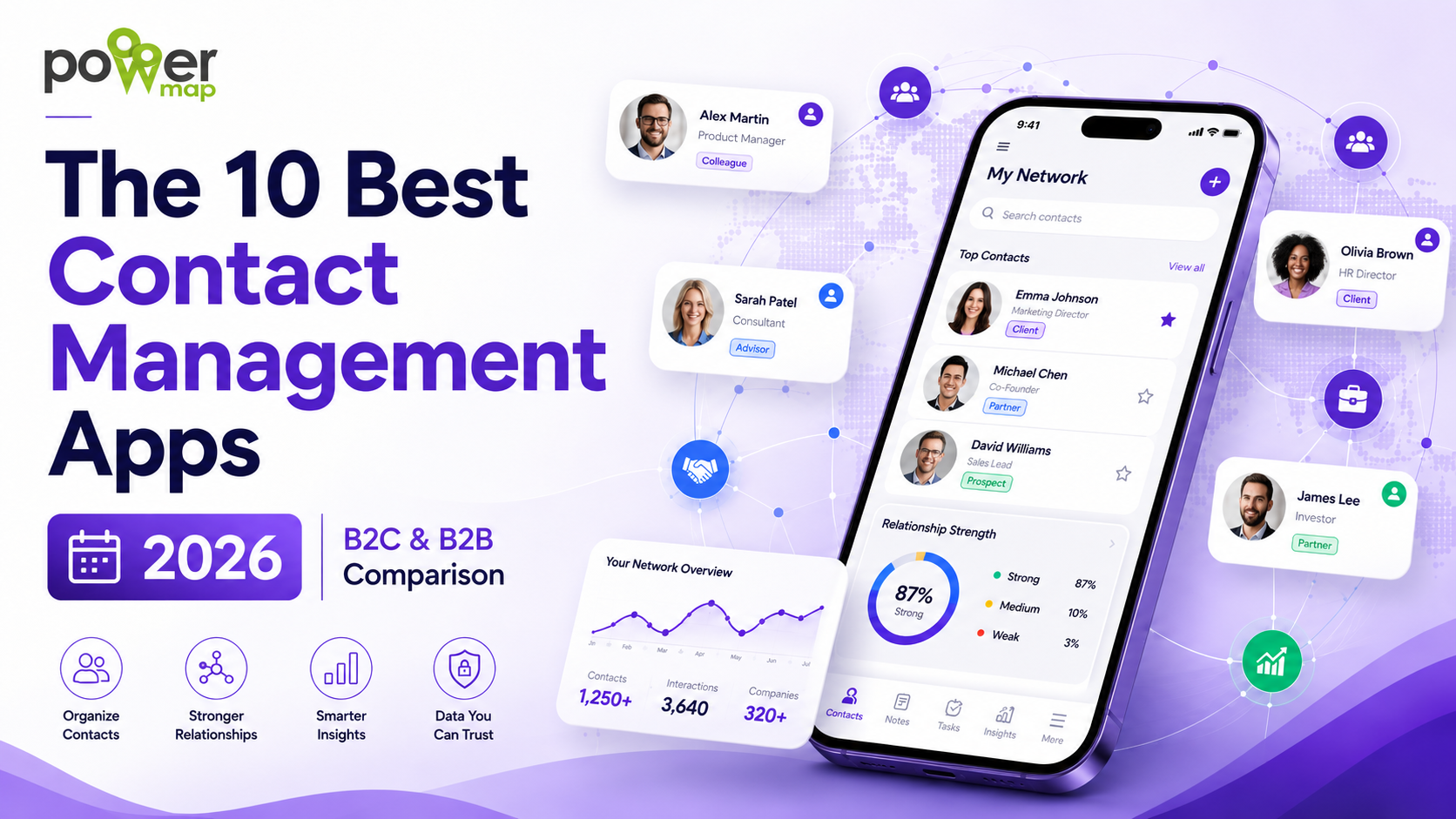
Your contact list may be one of the most valuable assets you own.
Friends, former colleagues, clients, prospects, investors, recruiters, suppliers, experts, partners, classmates and people you met at conferences all sit somewhere inside your phone, email accounts, social networks or CRM.
The problem is that storing contacts is not the same as managing relationships.
Traditional address books were designed to answer a very simple question:
“How can I contact this person?”
Modern contact management applications are increasingly expected to answer much more valuable questions:
This is why the contact management market is gradually splitting into three categories:
Address books, designed primarily to store and synchronize contact information.
Personal CRMs, designed to help individuals remember, nurture and reactivate relationships.
Business CRMs, designed primarily to manage leads, customers and sales pipelines.
And a fourth category is now emerging: Relationship Intelligence and Identity Relationship Management, where the objective is not simply to manage contacts, but to understand and activate your relationship capital across multiple identities.
Here are 10 of the most interesting contact management applications available in 2026.
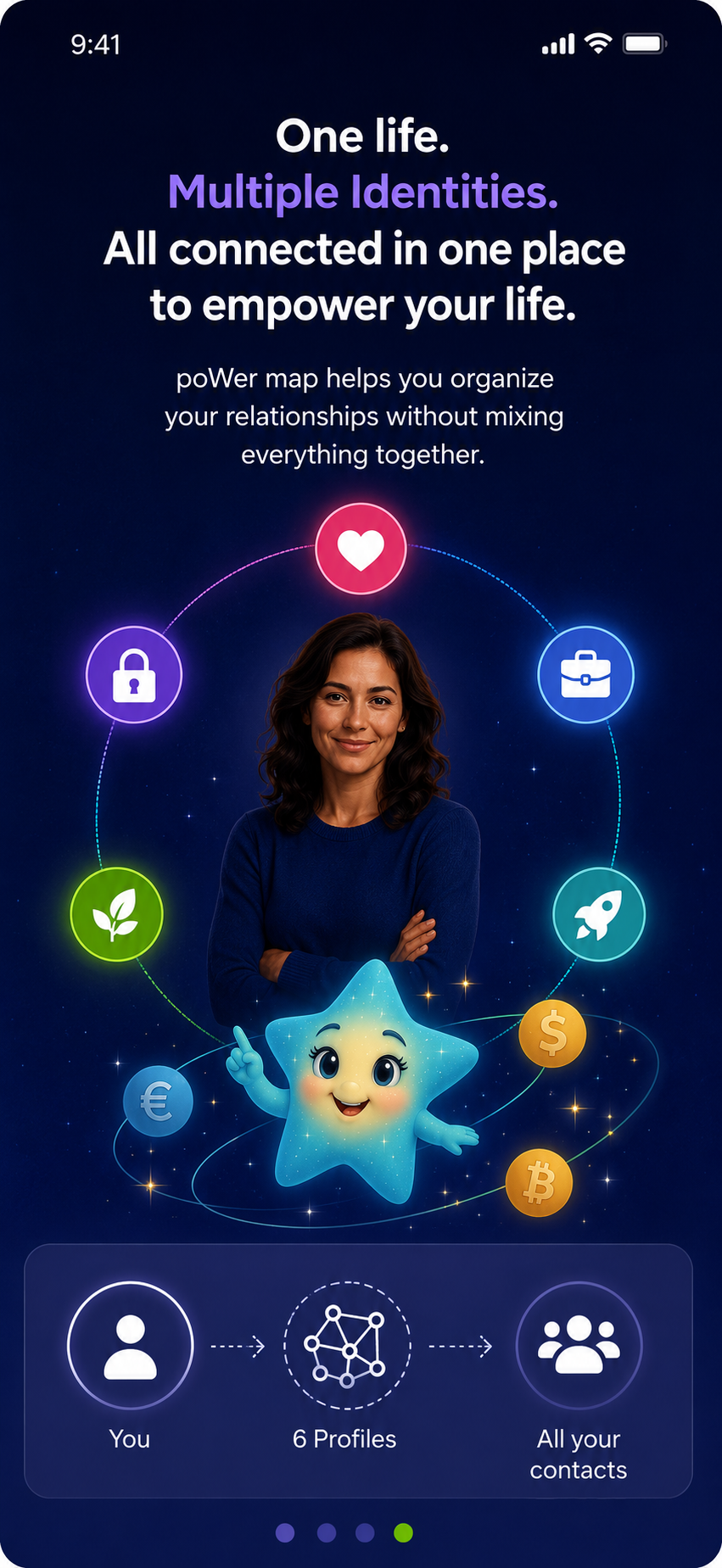
Organize your contacts, profiles, and personal brand in one app built for the new multi-identity economy.

Rating guide: ★★★★★ = excellent fit, ★☆☆☆☆ = very limited fit.
The right application therefore depends heavily on what you expect from a “contact”.
If a contact is essentially a phone number and email address, Google Contacts or Apple Contacts may be enough.
If a contact represents a relationship you want to nurture, Dex, Mesh or Contacts+ become much more interesting.
If a contact represents a lead in a commercial process, HubSpot or Cloze may be better suited.
And if your contacts represent your long-term relationship capital across several professional and personal identities, poWermap takes a fundamentally different approach.
poWermap starts from a different assumption:
your network belongs to you and should remain useful throughout your entire life and career.
Traditional contact applications store people.
Traditional CRMs store customers.
poWermap is designed to help users organize relationships, identities and professional assets.
The poWermap Contacts mobile application allows users to organize their address book, create different profiles, separate personal and professional networks and add more context to their relationships. The broader poWermap platform connects contacts with profiles, resumes, credentials, skills, business history, meetings and opportunities.
That distinction becomes increasingly important in a world where people may simultaneously be:
A single linear address book was never designed for this reality.
Most contact applications allow you to create groups, labels or tags.
That is useful—but a group is not an identity.
Your relationship with someone may depend on which version of yourself they know.
A consultant may have one network connected to their consulting activity, another to a startup, another to an association and another to their private life.
poWermap is specifically designed around this multi-identity reality. The platform positions Identity Relationship Management as an evolution beyond traditional CRM: relationships are organized around the different identities through which people interact.
This can become particularly valuable for:
Fractional executives working with several companies.
Consultants and advisors maintaining networks across multiple clients and industries.
Entrepreneurs simultaneously developing several projects.
Recruiters interacting with candidates, clients, managers and referrers.
Creators and public figures separating public, professional and private relationships.
Students and young professionals beginning to build relationship capital before entering the workforce.
Another important difference concerns ownership.
Corporate CRMs are normally organized around the company.
When an employee changes employer, access to years of business relationships, context and professional information can disappear overnight.
poWermap takes a more individual-centric approach.
Its objective is to help professionals maintain their contacts, profiles, resumes, credentials, projects and relationship history throughout their career. As the platform explains: when you leave a company, you should not lose the value of the relationships you helped build.
That makes poWermap particularly relevant to the rapidly growing population of professionals whose careers are becoming increasingly fragmented.
This is perhaps the biggest difference between poWermap and conventional personal CRMs.
A professional relationship is rarely just:
John Smith — +44 1234 567890.
What matters is the context around John.
What does he do?
Where did you work together?
Which skills does he know you for?
Which projects connect you?
Which credentials or case studies might be relevant to him?
Could he recommend you?
Could he introduce you to somebody?
Could he become a customer, employer, supplier, investor or business partner?
poWermap is designed to connect relationship information with professional content such as resumes, credentials, skills, profiles, meetings and business assets. It also supports multilingual professional information and integrations with enterprise tools.
That moves contact management closer to Relationship Intelligence.
Compared with Google Contacts, Apple Contacts and Outlook People, poWermap provides much deeper relationship and professional context.
Compared with Contacts+, poWermap goes beyond synchronization, enrichment and address-book hygiene.
Compared with Covve, it goes beyond business-card scanning and lead capture.
Compared with Dex and Mesh, poWermap places greater emphasis on multiple professional identities and on connecting relationships with professional assets.
Compared with HubSpot and Cloze, poWermap is less centred on a corporate sales pipeline and more centred on the individual and their long-term relationship capital.
This distinction can be summarized very simply:
A CRM asks: “How valuable is this person to our company?”
poWermap also asks: “How important is this relationship to you?”
For professionals whose network is becoming an increasingly important career and business asset, that is a significant difference.
Best for: consultants, fractional executives, entrepreneurs, advisors, recruiters, business developers, creators and multi-career professionals.
With our mobile app Power Map Contacts, organize your contacts, profiles, and identities in one app built for the multi-identity world.
Create personal, professional, or private profiles. Map your network. Take control of your personal brand.
If you previously knew Clay, the relationship management application became Mesh in March 2026 following its acquisition by Automattic.
Mesh is one of the strongest examples of the new generation of personal relationship managers.
Its promise is straightforward: bring together the people you know and help you remember what matters about them.
Mesh can combine information from emails, meetings, contacts and other integrations. It also surfaces career changes, news and reminders to reconnect with people. The service is available across web, macOS, Windows, iOS and Android.
Its biggest strength is automatic context.
Instead of manually maintaining every relationship, Mesh attempts to understand activity around your network and make it searchable.
For founders, executives and professionals with large personal networks, this can be extremely useful.
The team functionality is also interesting: Mesh can help organizations understand who knows whom and identify potential warm introductions.
Mesh is extremely strong at answering:
“What is happening in my network?”
poWermap adds another dimension:
“Through which identity does this relationship exist, and how can it connect to my professional capital?”
For someone with one dominant professional identity, Mesh may be sufficient.
For consultants, fractionals, creators and multi-career professionals managing several distinct networks, poWermap's identity-centric model can become more relevant.
Best for: founders, executives and professionals who want an intelligent personal CRM with strong automated relationship context.
Dex describes itself as a personal CRM “built for people, not sales pipelines.”
That description captures the product well.
It combines contacts from sources such as LinkedIn, email and calendars and adds reminders, notes and interaction context designed to help users maintain relationships.
In 2026, Dex also offers email and calendar integrations, two-way contact sync, custom fields, WhatsApp and messaging integrations, LinkedIn synchronization and professional features such as mail merge and API/Zapier access.
Dex is particularly good if your main problem is:
“I know many people, but I am terrible at keeping in touch with them.”
You can create reminders and maintain relationship history so valuable connections do not simply disappear because you forgot to follow up.
That makes it particularly attractive to:
Dex focuses heavily on relationship maintenance.
poWermap extends the concept toward relationship capital management.
For example, the objective is not only to remember that you know a former client, but potentially to connect that relationship with the relevant professional identity, experience, credentials, skills or business opportunity.
Dex is therefore an excellent personal CRM.
poWermap is aiming at a broader concept: an Identity Relationship Management platform.
Best for: professionals who need better follow-up discipline and want to maintain a large network more intentionally.
Contacts+ solves one of the oldest problems in contact management extremely well:
messy address books.
Most professionals accumulate contacts across several Google accounts, Outlook, Microsoft 365, iCloud and smartphones.
Duplicates appear.
Information becomes outdated.
Some contacts exist in one account but not another.
Contacts+ is designed to unify these sources into a cleaner address book.
It can synchronize contacts, remove duplicates, enrich data, create backups and synchronize multiple Google, iCloud and Outlook accounts. It also provides notes, tags, follow-up reminders and business-card scanning.
If your biggest problem is:
“My contacts are everywhere,”
Contacts+ is one of the strongest solutions in this list.
It bridges ecosystems that are normally separated and helps maintain one reliable contact database.
Contacts+ improves the quality of your address book.
poWermap attempts to increase the value of your network.
The difference is important.
Clean phone numbers and email addresses are necessary.
But they do not explain the relationship between two people, the context in which they know one another or which professional identity connects them.
For users wanting synchronization and contact hygiene, Contacts+ remains extremely attractive.
For professionals wanting to transform contacts into structured relationship capital, poWermap offers a broader model.
Best for: users with contacts scattered across multiple accounts and ecosystems.
Covve has evolved significantly from being a simple contact-management application.
Its 2026 positioning is increasingly focused on lead capture.
Users can scan business cards, event badges and LinkedIn QR codes, add contacts using voice and export or synchronize captured leads with other tools. Team plans add analytics, centralized lead management and CRM integrations with platforms including HubSpot, Salesforce, Pipedrive, Zoho and Microsoft Dynamics 365.
Covve also includes more relationship-oriented capabilities such as notes, reminders, tags, birthdays and relationship organization.
Covve is especially compelling during physical networking.
Imagine attending:
Instead of collecting dozens of paper business cards and processing them later, Covve can immediately transform those encounters into structured digital leads.
Covve is excellent at the moment of contact acquisition.
poWermap's larger ambition concerns what happens after that contact becomes part of your network.
How does that relationship evolve?
Which identity does it belong to?
What professional information should be connected to it?
How can the relationship contribute to future opportunities?
The two approaches can therefore be complementary rather than directly competitive.
Best for: salespeople, conference attendees, exhibitors and teams capturing large numbers of leads in the real world.
HubSpot is not primarily a personal contact manager.
It is a CRM—and a very powerful one.
The distinction matters.
HubSpot's mobile application allows users to create contacts, access CRM information, manage deals and use its Breeze AI capabilities to retrieve account information or prepare follow-up activity.
For businesses, this offers something most personal contact applications cannot provide:
a contact can be connected to a company, opportunity, sales pipeline, marketing activity and customer relationship.
HubSpot is the obvious choice when the question becomes:
“How do we convert this contact into revenue?”
It provides the commercial infrastructure around contacts.
For sales teams, marketing departments and customer-facing organizations, that is considerably more useful than a personal address book.
HubSpot's primary unit of value is the company's customer relationship.
poWermap places much more emphasis on the individual's relationship capital.
A salesperson may leave Company A and join Company B.
The corporate CRM stays with Company A.
But the salesperson's knowledge, reputation and professional network continue throughout their career.
This makes poWermap particularly interesting as a layer alongside traditional CRM systems rather than necessarily replacing them. The poWermap platform explicitly positions itself as capable of integrating with existing CRM and enterprise systems.
Best for: B2B sales, marketing and customer-success organizations needing structured pipelines and company-wide CRM processes.
Cloze sits somewhere between relationship intelligence and full CRM.
Its technology automatically brings contacts together, maintains information and creates company records. Business plans can also provide team-wide views of communication and relationship activity.
Cloze's current positioning has become particularly strong in the real-estate sector, where its platform combines CRM, marketing, lead management and AI-powered relationship intelligence for agents and brokerages.
Cloze understands something fundamental about sales:
not every opportunity begins with a cold lead.
Many opportunities already exist somewhere inside the relationships a company or team has developed.
The platform therefore puts considerable emphasis on surfacing hidden opportunities within existing networks.
Cloze remains primarily a commercial CRM environment.
poWermap is more individual- and identity-centric.
The question is therefore partly about ownership and purpose.
Are you managing a network primarily to sell a product?
Or are you building a relationship asset that may support your career, businesses, projects and identities for decades?
For the second use case, poWermap's broader identity and career perspective offers an important distinction.
Best for: relationship-driven sales organizations, particularly real-estate professionals and brokerages.
For millions of users, Google Contacts may be all the contact management software they ever need.
It is simple, integrated into Google's ecosystem and excellent at basic contact storage.
Google Contacts lets users create and edit contacts, organize them using labels, import and export records, synchronize contacts across devices and identify and merge duplicates.
Simplicity.
If you primarily need:
there may be little reason to install something more complex.
Google Contacts knows who somebody is.
It knows much less about why your relationship with that person matters.
There is no real relationship lifecycle, multi-identity model or professional capital layer.
This makes Google Contacts an excellent address book—but not really a relationship intelligence platform.
Best for: individuals and Google Workspace users wanting reliable, simple and largely frictionless contact storage.
Apple Contacts performs a similar role for iPhone, iPad and Mac users.
Its greatest strength is invisible integration.
Contacts are available throughout Apple's communication ecosystem with very little configuration.
Apple also provides tools for identifying and merging duplicate contacts and can combine contact cards originating from different accounts into a unified view.
For private B2C use, simplicity is often an advantage rather than a limitation.
You may not need relationship scores, pipelines, reminders or artificial intelligence to call your parents or message a friend.
Apple Contacts does the basic job extremely well.
The application remains fundamentally an address book.
For consultants, salespeople, founders or executives managing several thousand strategically important relationships, there is not enough context to transform the contact list into an active professional network.
That is where personal CRMs and relationship intelligence platforms become valuable.
Best for: consumers heavily invested in the Apple ecosystem.
Microsoft Outlook's People functionality is sometimes overlooked because it sits inside the broader Outlook and Microsoft 365 environment.
It nevertheless provides useful contact management features.
Users can create, edit, search and organize contacts and contact lists. Outlook can also surface recent emails, files, calendar meetings and organizational information around contacts, depending on the Microsoft environment being used.
For corporate users, Outlook can additionally connect personal contacts with company directory information, providing useful organizational context.
Its main advantage is context within Microsoft 365.
If most of your professional life already happens through:
the People experience requires little additional effort.
Microsoft's model naturally revolves around your Microsoft account and, in corporate environments, your employer.
poWermap is designed around you.
Your professional identity can evolve.
Your employer can change.
Your business activities can change.
Your roles can multiply.
Your relationships, however, remain part of your long-term professional capital.
That distinction becomes increasingly important as linear careers give way to portfolio careers.
Best for: employees and organizations already deeply integrated into the Microsoft 365 ecosystem.
The expression “contact management application” now describes several very different products.
Before choosing one, decide what problem you are actually trying to solve.
You simply want a reliable address book.
Your main problem is duplicate contacts and synchronization between different ecosystems.
You frequently meet new people at conferences and events and need efficient lead capture.
You know many people but need reminders and better follow-up habits.
You want AI and automation to continuously create context around your personal and professional network.
Contacts primarily represent leads and customers inside a sales pipeline.
Relationship-driven selling is central to your business, especially in real estate.
Your professional contacts already live primarily inside Microsoft 365.
Your network is becoming a personal and professional asset.
You manage several identities.
You work with several organizations.
You combine employment, consulting, entrepreneurship, advisory work or other activities.
You want your relationship capital to remain useful beyond one job, one company or one CRM.
And you believe your contacts should contain more than names, phone numbers and email addresses.
For decades, contact-management software focused on building a better address book.
Then CRM platforms transformed contacts into customers.
Personal CRMs added reminders and relationship history.
The next transformation may be much bigger.
AI is fragmenting careers.
Freelancing and fractional work are expanding.
Professionals increasingly operate through several organizations, communities and professional identities.
Creators separate public and private personas.
Entrepreneurs build multiple businesses.
Employees become consultants.
Consultants become investors.
Executives become advisors.
In this environment, the professional question is no longer simply:
“Who do I know?”
It becomes:
“Who knows which version of me—and what can we create together?”
This is the idea behind Identity Relationship Management.
And it explains why poWermap sees the contact list not as a database, but as the beginning of something much more valuable:
your Relationship Capital.


