
September 4, 2026
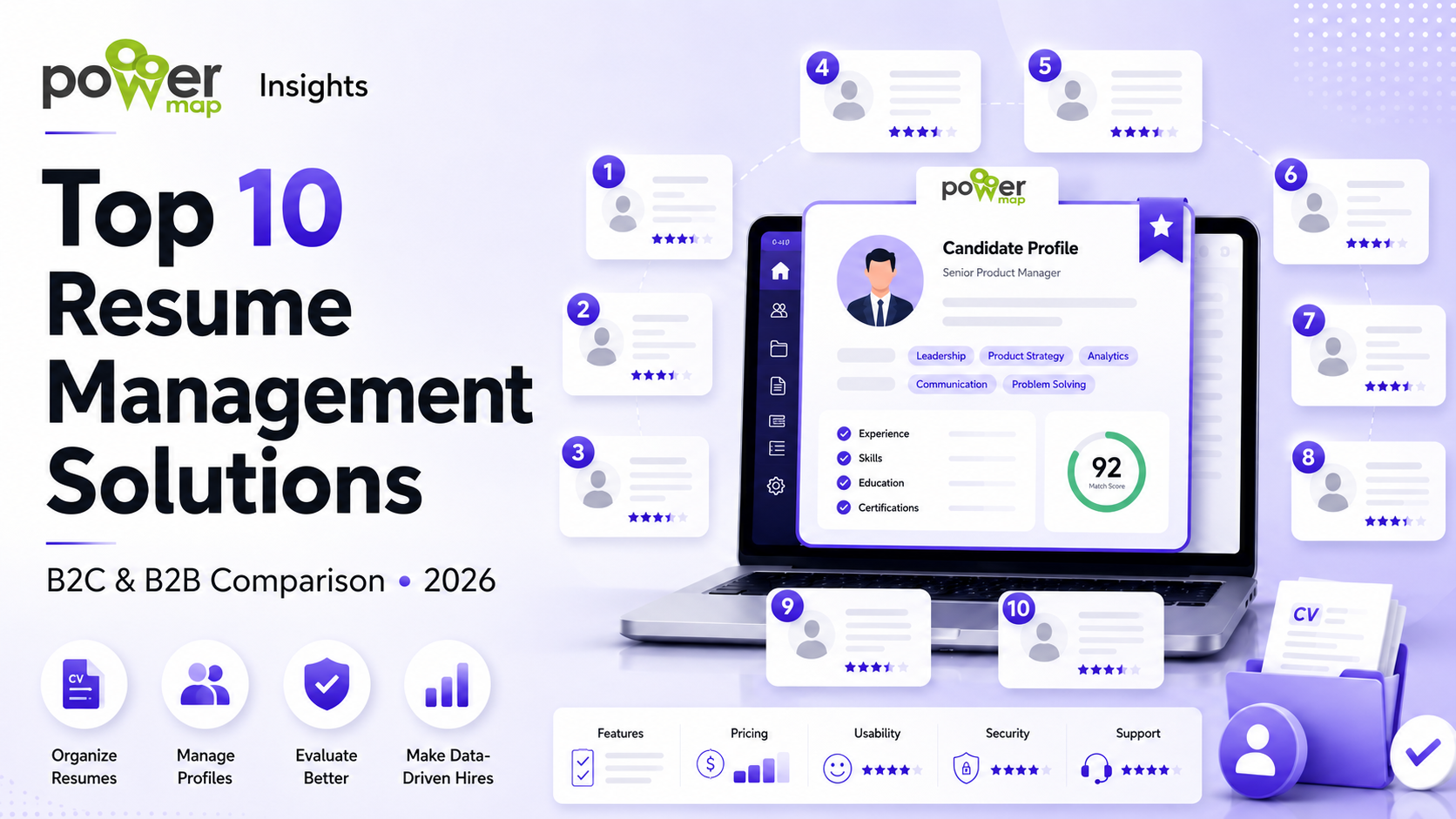
Discover the 10 best resume management solutions in 2026 for individuals and businesses. Compare leading platforms for CV creation, AI and ATS optimization, multiple resume versions, job tracking, professional profiles, and relationship management—and see how poWermap goes beyond traditional resume builders by turning resumes, skills, credentials, contacts, and professional identities into living career assets.
A resume is no longer just a PDF file you update every three years.
Modern professionals may need several versions of their resume for different jobs, clients, industries, countries, languages, or professional identities. Freelancers and fractional executives can simultaneously be consultants, entrepreneurs, advisors, speakers, investors, or employees. Consulting firms, recruiters, and professional services companies face an even greater challenge: keeping hundreds or thousands of employee and candidate resumes accurate, searchable, branded, and ready to use.
As a result, a new generation of resume management solutions has emerged.
Some focus primarily on creating beautiful resumes. Others specialize in ATS optimization, AI-assisted writing, job application tracking, or career management.
A smaller group is going further by treating the resume as a living professional asset connected to skills, credentials, projects, references, contacts, and relationships.
This guide compares ten of the most relevant resume management platforms in 2026 for both individual users — B2C — and organizations — B2B.
A resume builder helps you create a document.
A resume management solution should ideally help you manage the information behind that document throughout your career.
Depending on the platform, that can include:
This distinction matters.
If your only objective is to create a good-looking PDF, dozens of excellent tools can do the job.
If you want to manage your professional capital over several years, the choice becomes very different.
Organize your contacts, profiles, and personal brand in one app built for the new multi-identity economy.

* Some poWermap AI, skills and career-management capabilities are part of its evolving product roadmap.
The B2B rating in this comparison refers specifically to the ability to manage professional profiles, resumes, credentials or related information across an organization. It should not be confused with being a traditional Applicant Tracking System.
Most resume platforms start with a simple question:
“How can we help you create a better resume?”
poWermap starts with a broader one:
“How can we help you manage and increase the value of your professional capital?”
That difference explains why poWermap occupies a unique position in this comparison.
poWermap is designed as a relationship intelligence and personal asset management platform bringing together resumes, professional profiles, contacts, identities, skills, credentials, project references, relationships and business-development information.
Instead of seeing the resume as an isolated document, poWermap considers it one representation of a much larger professional ecosystem.
Traditional resume builders implicitly assume that one person has one main career identity.
That is becoming increasingly unrealistic.
A consultant may simultaneously be:
Each identity can require different:
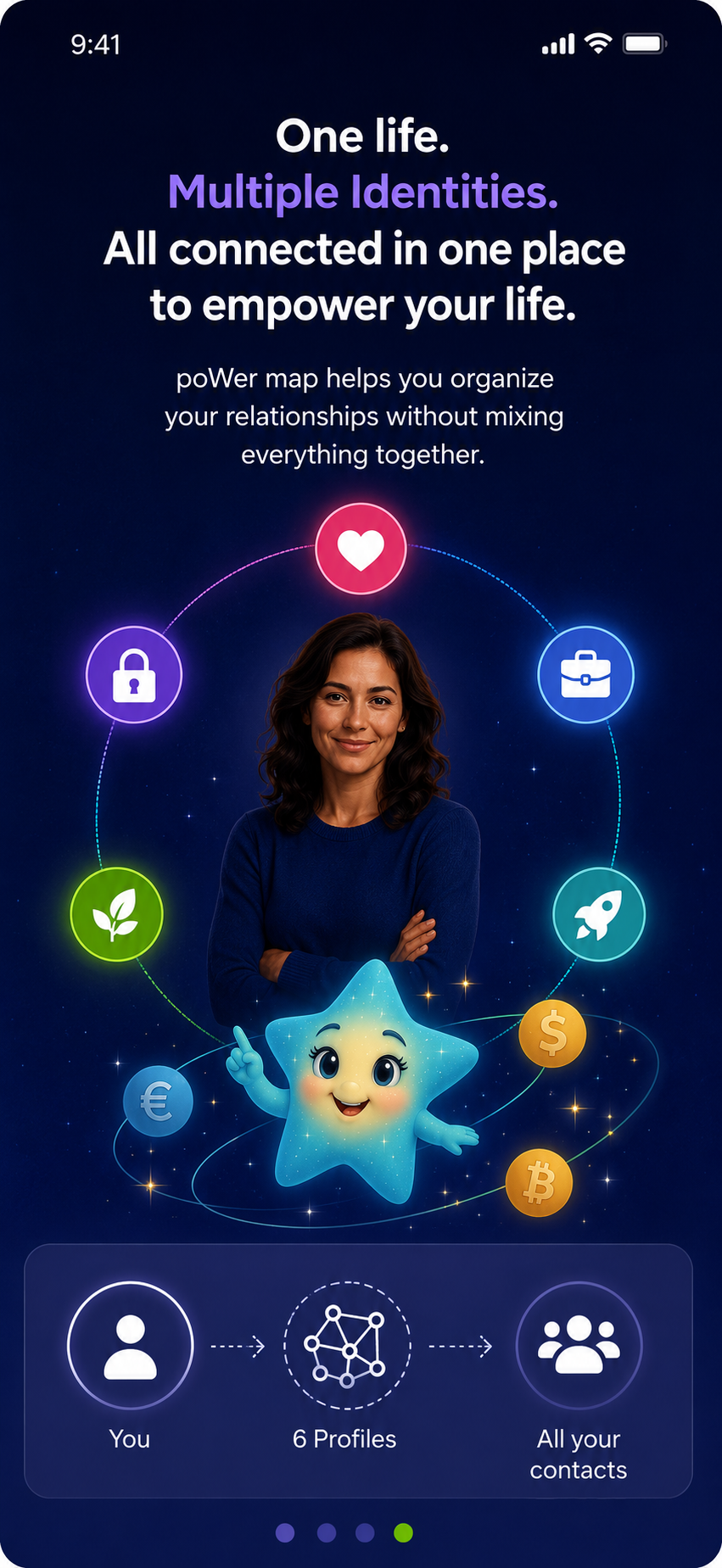
Multi-identity management is therefore a core part of the poWermap proposition. Its individual plans are designed to let users separate personal and professional profiles rather than forcing their entire professional life into a single public identity.
Teal, Huntr, Rezi and other career platforms are excellent at creating different resume versions for different applications.
poWermap goes one level higher: the resume version can belong to a different professional identity and relationship ecosystem.
That distinction becomes especially important for freelancers, consultants, fractional executives, creators and portfolio-career professionals.
Companies still commonly store employee resumes as:
The obvious problem is that these documents quickly become obsolete.
poWermap Enterprise is designed to centralize and transform these static resumes into structured professional profiles that can be updated, enriched, searched, compared and reused.
This creates an interesting B2B use case for:
This may be poWermap's most significant difference from almost every B2C resume builder in this ranking.
In professional services, a resume is not used only to find a job.
A consultant's resume can also be a sales asset.
It may be inserted into:
poWermap explicitly addresses this use case, including the management of resumes and credentials in business-ready formats such as PowerPoint, company branding, templates and reuse in sales processes.
Traditional resume builders optimize a candidate to get hired.
poWermap can also help an organization present its people to win business.
That is a fundamentally different value proposition.
Your professional value is not determined exclusively by what you know.
It is also influenced by:
what you have done, what you can prove, and who knows and trusts you.
poWermap therefore connects professional information with contacts and relationship capital.
The platform is designed around a broader ecosystem including:
Resume → Skills → Credentials → Projects → References → Contacts → Relationships → Opportunities
That creates something closer to a Human Capital Wallet combined with Relationship Intelligence than a conventional CV builder. poWermap's own terminology describes users as retaining control over assets including skills, experiences, certifications, references, relationships and identities.
The enterprise proposition extends the individual model to organizations.
Its positioning includes:
Several advanced capabilities remain part of the platform's roadmap or enterprise rollout, so organizations should distinguish currently available functionality from upcoming features when evaluating the platform.
B2C: consultants, freelancers, fractional executives, sales professionals, recruiters, entrepreneurs and multi-career professionals.
B2B: consulting firms, professional services companies, recruiters, staffing firms and organizations where employee expertise and relationships directly contribute to revenue.
The main poWermap difference can be summarized in one sentence:
Other solutions help you manage your resume. poWermap aims to help you manage the professional capital behind your resume.
With our mobile app Power Map Contacts, organize your contacts, profiles, and identities in one app built for the multi-identity world.
Create personal, professional, or private profiles. Map your network. Take control of your personal brand.
Teal has become one of the strongest platforms for professionals running an active job search.
Its Resume Builder lets users import an existing resume or LinkedIn profile, maintain their professional history and create customized resume versions for individual positions. Teal combines this with its Job Tracker, Chrome extension, company tracking and contact tracking.
That combination makes Teal particularly effective for candidates who are applying to many positions simultaneously.
Teal's free tier is also notable: core functionality includes editing and exporting unlimited resumes, bookmarking unlimited jobs and tracking networking contacts.
Teal remains primarily built around the job-seeker journey.
Its contact management is valuable because networking supports a job search, but it is not designed to become an enterprise-wide relationship intelligence platform or a long-term repository of corporate credentials and business-development assets.
Professionals actively applying to multiple jobs and wanting one central workspace for resumes, applications and job-search organization.
B2C: Excellent
B2B: Limited
Huntr is another strong all-in-one career management platform.
It combines an AI Resume Builder with a Job Tracker, Contact Tracker, Interview Tracker, job-search metrics, resume checking, cover letters and application autofill.
For highly active job seekers, this can remove a significant amount of administrative work.
Instead of maintaining a spreadsheet containing applications, another document containing contacts and several folders containing resumes, users can manage much of the process from one environment.
Huntr also provides offerings for organizations including universities, career centers, bootcamps, career coaches, workforce development organizations and outplacement providers.
This gives it a stronger B2B dimension than many consumer resume builders.
Its core workflow still revolves around getting the individual candidate through the recruitment process.
Compared with poWermap, it is less focused on multiple professional identities, corporate credentials, employee relationship capital and using professional profiles as reusable sales assets.
Job seekers who want an integrated personal CRM for their entire application process.
B2C: Excellent
B2B: Strong
Rezi has built its reputation around a very specific problem: creating resumes that are easy for Applicant Tracking Systems to understand.
Users can create or import a resume, receive a Rezi Score, identify missing keywords, generate bullet points and summaries, tailor the content to individual vacancies and export documents in several formats.
Its focus on structured content rather than purely visual design makes it particularly attractive for candidates applying to large companies where ATS systems are commonplace.
Rezi also has a genuine B2B proposition through Rezi Enterprise, including white-label resume technology for organizations.
Its center of gravity remains resume performance against recruitment systems.
Rezi is therefore an excellent optimization engine but is not primarily intended to map relationships, multiple identities or business-development credentials around the resume.
Candidates concerned about ATS performance and organizations wanting to provide structured resume-building technology to their users.
B2C: Excellent
B2B: Strong
Kickresume combines AI writing with a particularly strong focus on presentation.
Its AI Resume Writer can create or rewrite resume content, tailor it to a role and combine that content with customizable templates. The platform also includes resume checking, ATS tools, cover letters, personal websites and career-oriented tools.
One especially interesting feature is the ability to convert a resume into a personal website, helping candidates move beyond a purely downloadable document.
Kickresume supports resume translation into several languages and offers mobile access, making it useful for internationally mobile candidates.
Kickresume's greatest strengths remain the creation, presentation and improvement of the resume itself.
It is less suited to organizations attempting to connect hundreds of professional profiles with credentials, customer references and relationship intelligence.
Individuals who want AI assistance without sacrificing visual quality.
B2C: Excellent
B2B: Moderate
Enhancv is particularly strong for candidates who believe their resume should communicate more than a chronological list of jobs.
The platform combines professional templates, AI-assisted writing, resume checking and job-description matching while offering substantial design flexibility.
Its AI Resume Builder supports resumes in more than 20 languages, while its translation functionality extends across an even larger set of languages.
Enhancv's resume checker evaluates both content and ATS compatibility, including formatting, keywords and recruiter-oriented criteria.
Enhancv is primarily centered on creating a compelling candidate document rather than maintaining company-wide relationship or credential databases.
Professionals who want to balance visual differentiation, personal storytelling and ATS compatibility.
B2C: Excellent
B2B: Limited
VisualCV deserves particular attention in a list about resume management, because managing multiple CVs is explicitly part of its proposition.
Users can create separate CV versions for different applications instead of continually overwriting one master document.
Even more interestingly, VisualCV provides analytics showing when a shared CV has been viewed or downloaded.
That makes a resume less like a static attachment and more like a trackable digital asset.
VisualCV does an excellent job of managing documents, but it does not attempt to become a full relationship intelligence or multi-identity platform.
It therefore sits somewhere between a traditional resume builder and a true professional-information-management solution.
Candidates, consultants and executives who regularly send different versions of their CV and want to know whether recipients opened them.
B2C: Excellent
B2B: Moderate
Resume.io combines a polished resume builder with an increasingly broad range of career tools.
Its current platform includes AI-assisted resume creation, job-description tailoring, recruiter matching, job discovery, cover letters, interview preparation and career services.
Resume.io also provides a Job Tracker for organizing applications throughout the recruitment process.
That makes it considerably broader than a basic template website.
Like most career platforms in this ranking, the ecosystem is organized primarily around one event:
finding your next job.
For professionals whose resumes are also used for consulting assignments, commercial proposals, board activities, entrepreneurial projects or several simultaneous identities, that model can become restrictive.
Mainstream job seekers wanting a simple, guided environment covering most stages of a conventional job search.
B2C: Excellent
B2B: Limited
Jobscan is less about designing a resume and more about answering one critical question:
How closely does your resume match this particular job description?
Its Resume Scanner compares the candidate's document against an individual vacancy, analyzes keywords, skills, formatting and ATS-related factors, and returns a Match Rate with recommendations.
The platform now extends beyond scanning into resume creation, optimization, LinkedIn optimization, job tracking and other career tools.
Jobscan is an optimization layer rather than a comprehensive professional identity management system.
Its value is greatest immediately before an application.
It is less relevant for managing a person's professional information continuously between job searches.
Candidates applying to ATS-heavy employers who want to optimize every application against the exact job description.
B2C: Excellent
B2B: Moderate
Canva is not a specialized resume management platform, but it remains difficult to ignore because of its enormous design ecosystem.
Its resume tools provide access to a large library of customizable templates and graphic elements, making it particularly attractive to professionals in creative industries.
Where many resume platforms tell users what their CV should say, Canva gives users extensive freedom over how it should look.
That flexibility comes with a trade-off.
Canva is fundamentally a design platform, rather than a resume intelligence platform.
It does not provide the same depth of resume-specific management, ATS matching, application tracking, skill management or relationship intelligence found in specialized solutions.
Candidates should also be cautious with highly graphical layouts when applying through Applicant Tracking Systems.
Designers, marketers, creators and professionals applying directly to humans rather than primarily through automated recruitment systems.
B2C: Strong
B2B: Moderate
There is no universal winner because the platforms solve different problems.
You are actively applying to many jobs and need to organize applications, resume versions and networking activity.
You want a personal job-search CRM combining resumes, applications, interviews and contacts.
Passing ATS screening and optimizing keywords are your top priorities.
You want AI to create an attractive resume quickly.
Personal storytelling, international applications and visual differentiation matter.
You maintain several resume versions and want analytics when sharing them.
You want an easy-to-use, broad career toolkit.
You want to optimize an existing resume against individual job descriptions.
Design freedom matters more than sophisticated career-management functionality.
You no longer think of your resume as merely a document.
If you have several professional identities, work as a consultant or fractional executive, manage a valuable professional network, need to connect your experience with credentials and references, or work for an organization that regularly sells the expertise of its people, poWermap's broader approach becomes particularly relevant.
One of the most important changes in the market may ultimately have little to do with artificial intelligence.
It is ownership of professional information.
Historically, the individual maintained a CV.
The employer maintained an employee profile.
LinkedIn maintained the public professional identity.
Recruiters maintained candidate databases.
CRMs maintained business relationships.
Consulting firms maintained credentials.
Phones maintained contacts.
As a result, the professional identity of a single person became fragmented across dozens of databases and documents.
The emerging generation of professional platforms may reverse this logic.
Instead of creating another copy of the person for every organization, professionals could maintain a structured digital professional asset containing:
Different resumes could then become different views of the same trusted professional data.
This is close to the direction poWermap describes through concepts such as the Human Capital Wallet, relationship capital, multiple identities and user-controlled professional assets.
Generative AI is making resume writing dramatically easier.
Soon, generating a professionally written CV will be almost trivial.
Give an AI your career history and a job description and it can already rewrite your summary, select keywords, reorganize experiences and create a targeted application in seconds.
That means the competitive advantage is moving elsewhere.
The difficult questions become:
Is the information accurate?
Can the experience be verified?
Which skills can the person actually demonstrate?
Which references support those claims?
Which professional identity should be presented?
Which relationships can create the opportunity?
Who controls this professional information?
The future of resume management may therefore move from document creation toward professional asset management.
The resume will still exist.
But it may simply become one dynamically generated view of something much more valuable:
your human capital, your identity capital and your relationship capital.
And that is precisely where the next generation of resume management platforms is beginning to emerge.


