
August 6, 2026
As AI makes knowledge increasingly accessible, students can no longer rely solely on degrees to build their future. Discover why networks, reputation, communities, and digital identity may become the most valuable forms of capital in the emerging Multi-Identity Economy—and why every student should start building their digital double before graduation.

In 1997, a student entering Stanford, Harvard, MIT, or Berkeley could reasonably believe that academic credentials would be the primary determinant of future career success.
Study hard.
Earn a degree.
Find a job.
Build a career.
For decades, this formula worked remarkably well.
Today, however, a growing number of economists, technologists, sociologists, and labor market researchers are questioning whether this model will remain sufficient in the age of artificial intelligence.
Not because education is becoming irrelevant.
But because knowledge itself is becoming abundant.
When every student has access to AI systems capable of writing, coding, researching, designing, translating, tutoring, and creating content, the economic value of information changes.
The scarcity shifts elsewhere.
And increasingly, it appears to be shifting toward something profoundly human:
Trust.
Relationships.
Reputation.
Communities.
Identity.
Throughout economic history, societies have repeatedly redefined what creates value.
The agricultural economy rewarded land ownership.
The industrial economy rewarded capital ownership.
The information economy rewarded knowledge.
The AI economy may reward something different:
Identity Capital.
Identity Capital can be defined as the cumulative value generated by a person's reputation, relationships, trust networks, communities, experiences, expertise, and public presence.
Unlike financial capital, Identity Capital cannot simply be purchased.
Unlike knowledge, it cannot be copied instantly.
Unlike software, it cannot be infinitely replicated.
It is accumulated through human interaction.
And in an increasingly automated world, that makes it valuable.
Organize your contacts, profiles, and personal brand in one app built for the new multi-identity economy.

One of the earliest thinkers to recognize this shift was entrepreneur and LinkedIn co-founder Reid Hoffman.
In The Start-Up of You, Hoffman argued that individuals should no longer manage their careers as employees navigating corporate ladders.
Instead, they should manage themselves as startups.
The implication was profound.
Every individual becomes responsible for:
What seemed visionary in 2012 increasingly resembles reality in 2026.
Today's students are not merely preparing for jobs.
They are preparing to become platforms.
Recent reports from the World Economic Forum suggest that technological transformation is accelerating across nearly every sector of the economy.
The discussion is often framed around jobs disappearing.
This is the wrong lens.
Historically, technology rarely eliminates work entirely.
Instead, it redistributes value.
Tasks become automated.
Skills evolve.
Entire professions transform.
The winners are rarely those who resist change.
They are those who position themselves where value is migrating.
Increasingly, that value appears to be moving toward uniquely human capabilities:
These capabilities are not separate from Identity Capital.
They are Identity Capital.
Students often underestimate the long-term value of their university network.
Yet history suggests otherwise.
Some of the world's most influential companies emerged from university relationships:
The founders did not simply create products.
They leveraged relationships.
Investors often describe startup ecosystems as networks rather than markets.
The same principle applies to individual careers.
The classmate sitting beside you today may become:
The challenge is that most students treat these relationships casually.
They collect contacts.
They do not cultivate networks.
Sociologist Pierre Bourdieu introduced the concept of social capital decades ago.
His central insight was simple:
relationships create economic value.
Not all opportunities emerge from skills alone.
Many emerge from trust.
Networks provide access to information, introductions, mentorship, and resources.
Historically, social capital was difficult to quantify.
Digital technologies are changing that.
Today, influence can be measured.
Reputation can be tracked.
Communities can be mapped.
Networks can be visualized.
Identity Capital is making social capital visible.
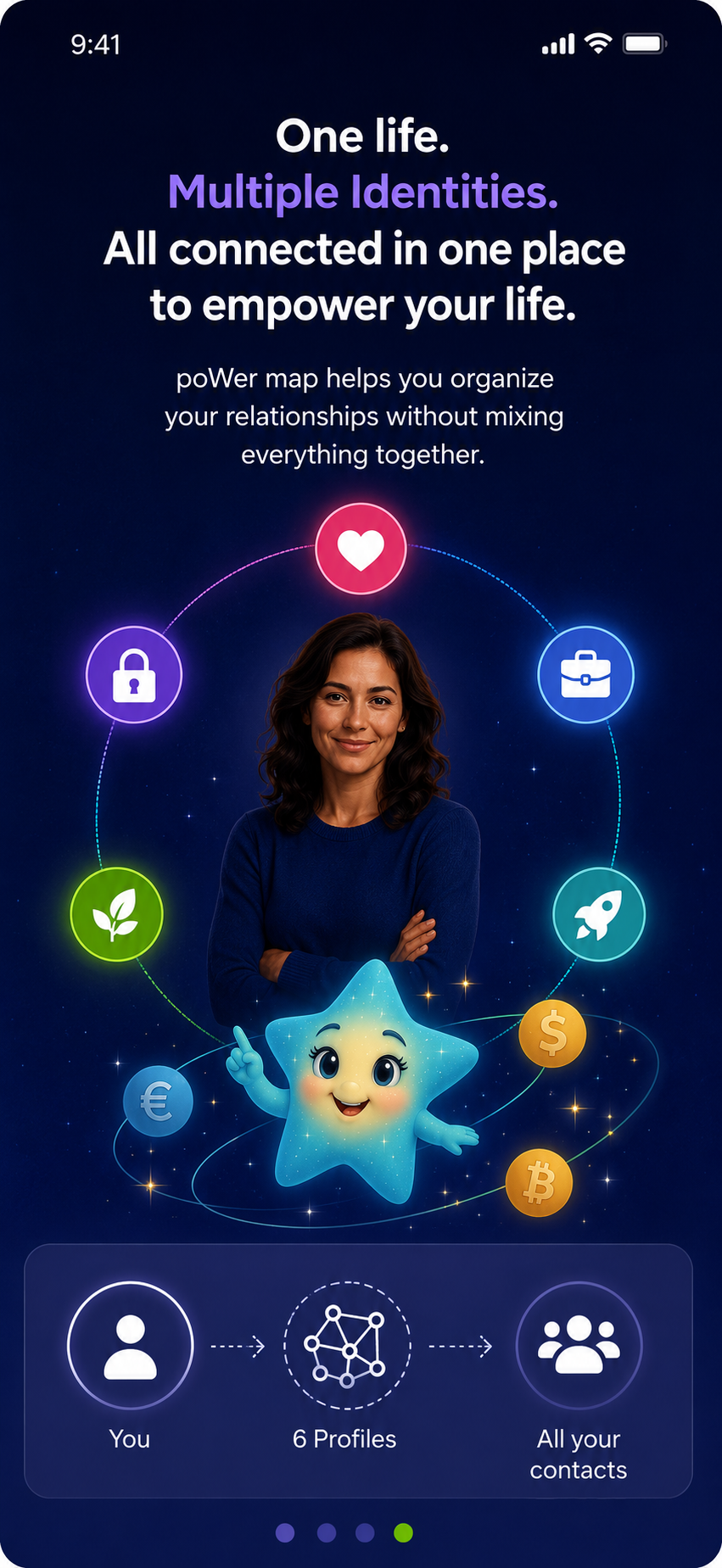
With our mobile app Power Map Contacts, organize your contacts, profiles, and identities in one app built for the multi-identity world.
Create personal, professional, or private profiles. Map your network. Take control of your personal brand.
If Identity Capital becomes increasingly important, another question naturally follows:
How should it be managed?
The answer may be the emergence of what can be called a digital double.
A digital double is not a fake identity.
Nor is it a virtual avatar in the science-fiction sense.
Instead, it is a structured digital representation of an individual's capabilities, experiences, relationships, achievements, communities, and aspirations.
Think of it as the living operating system of your professional and personal identity.
It evolves continuously.
It grows with experience.
It accumulates trust.
It becomes discoverable.
And eventually, it may represent you before you enter the room.
Recruiters may meet your digital double first.
Investors may evaluate it first.
Potential collaborators may interact with it first.
Communities may trust it before they trust you.
Generation Alpha may become the first generation for whom multiple identities are entirely normal.
A teenager may simultaneously be:
Each identity creates different opportunities.
Each identity attracts different communities.
Each identity generates different forms of trust.
The traditional idea of a single professional identity may gradually disappear.
Instead, future individuals may manage portfolios of identities.
Just as investors manage portfolios of assets.
If people manage multiple identities, they will inevitably manage multiple networks.
This is where Identity Relationship Management (IRM) emerges.
CRM helped companies manage customer relationships.
IRM helps individuals manage identity relationships.
The objective is not merely to store contacts.
The objective is to understand:
In the same way that CRM became essential for organizations, IRM may become essential for individuals.
For much of the twentieth century, education was the primary competitive advantage.
For much of the early internet era, technical skills became the primary competitive advantage.
In the AI era, the advantage may increasingly belong to individuals who combine:
The students who begin building these assets early may enjoy compounding advantages throughout their lives.
Not because AI replaces them.
But because AI amplifies the importance of what remains uniquely human.
The next generation will not compete solely through knowledge.
Knowledge is becoming abundant.
They will compete through trust.
Through reputation.
Through relationships.
Through communities.
Through identity.
Students entering college today are not simply building résumés.
They are building Identity Capital.
The question is no longer whether these assets matter.
The question is whether young people will begin managing them intentionally.
Because in the emerging Multi-Identity Economy, the most valuable investment a student can make may not be in a stock portfolio.
It may be in the network, reputation, and digital double they begin building long before graduation.


