
August 6, 2026
Followers create visibility. Networks create opportunities. Discover why the most successful creators, founders, and professionals focus less on audience size and more on building relationship capital in the emerging Identity Economy.
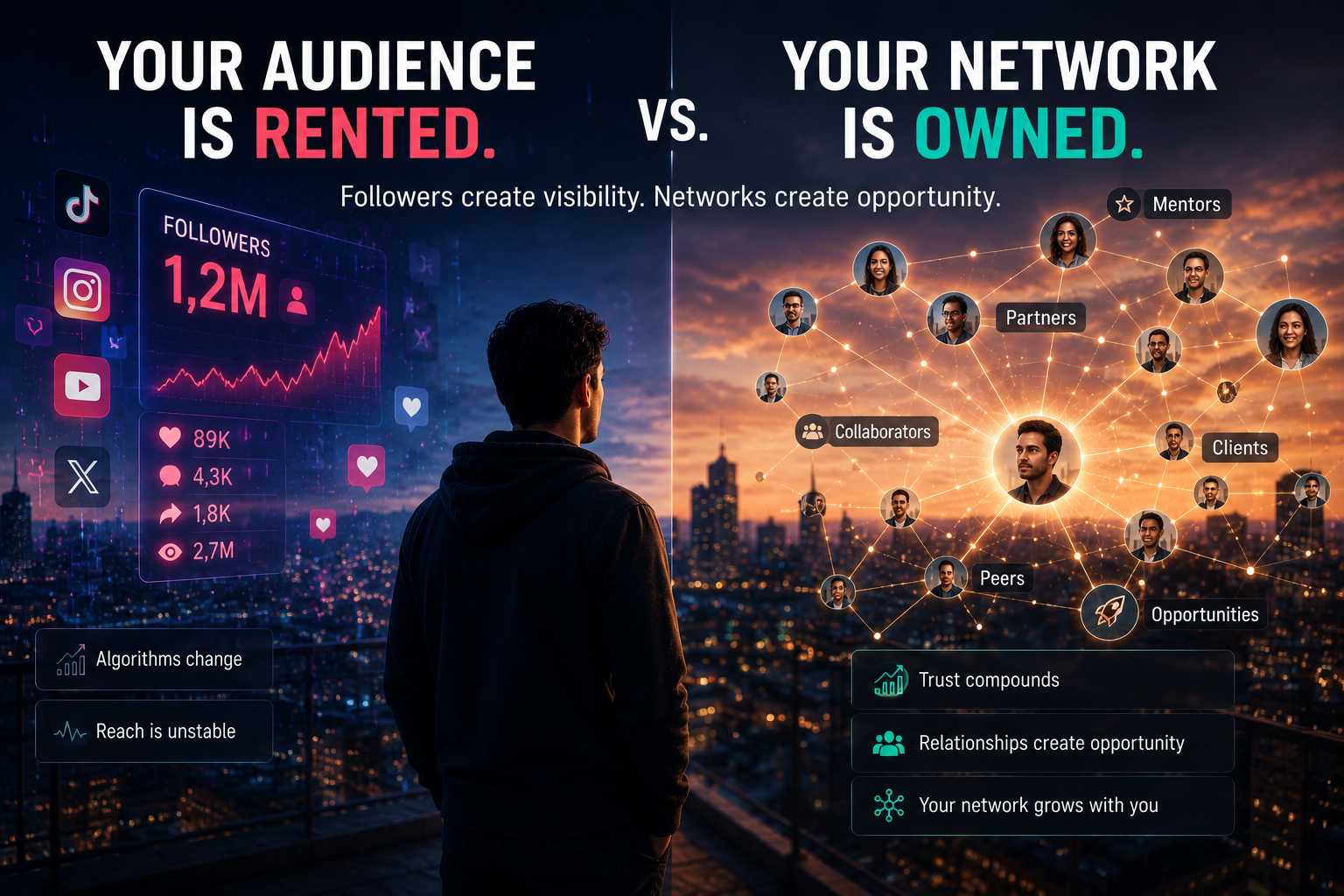
For more than a decade, the Creator Economy has trained us to focus on one metric above all others:
Followers.
The number sits at the top of every profile.
It influences sponsorship deals.
It shapes social status.
It determines perceived influence.
The internet has created a generation obsessed with audience size.
But what if we have been measuring the wrong thing?
What if the most valuable asset a creator, entrepreneur, consultant, executive, student, or influencer can build isn't an audience at all?
What if it is their network?
The difference may seem subtle.
In reality, it changes everything.
Social media platforms created a simple narrative.
More followers equals more influence.
More influence equals more opportunities.
More opportunities equals more success.
The logic appears sound.
Yet reality tells a different story.
Every year, thousands of creators with millions of followers struggle to generate sustainable income.
At the same time, entrepreneurs, consultants, investors, and niche creators with relatively small audiences build extraordinary careers and businesses.
Why?
Because audiences and networks are not the same thing.
Audiences consume.
Networks collaborate.
Audiences generate attention.
Networks generate opportunity.
Organize your contacts, profiles, and personal brand in one app built for the new multi-identity economy.

The modern technology industry provides one of the clearest examples of this principle.
Some of the world's most influential companies emerged not from massive audiences but from powerful networks.
The founders of:
did not begin with millions of followers.
They began with relationships.
Classmates.
Mentors.
Investors.
Advisors.
Collaborators.
Opportunity flowed through networks long before it appeared through audiences.
The same principle applies to creators.
The creator with the strongest network often outperforms the creator with the largest audience.
Decades before social media existed, sociologist Pierre Bourdieu introduced the concept of social capital.
His core insight was simple:
relationships have economic value.
Not all opportunities emerge from talent.
Not all opportunities emerge from knowledge.
Many emerge from access.
Who trusts you.
Who recommends you.
Who introduces you.
Who invites you.
Who thinks about you when an opportunity appears.
These invisible advantages accumulate over time.
Social capital compounds.
One of the most overlooked realities of the Creator Economy is that creators do not own their audiences.
Platforms do.
Algorithms control visibility.
Policies change.
Accounts disappear.
Reach fluctuates.
The creator with one million followers is often more dependent on platform decisions than they realize.
Networks operate differently.
A trusted relationship remains valuable regardless of which platform dominates next year.
An investor relationship survives algorithm updates.
A mentor relationship survives platform migrations.
A business partnership survives social media trends.
Followers are rented attention.
Networks are owned relationships.
Artificial intelligence is rapidly making content creation abundant.
Articles can be generated.
Videos can be generated.
Images can be generated.
Music can be generated.
As content becomes easier to produce, trust becomes more valuable.
Trust is fundamentally relational.
It does not exist between a creator and an algorithm.
It exists between people.
The future economy may increasingly reward individuals who can build trust at scale.
This is one reason why networks are becoming more valuable than audiences.
Trust travels through relationships.
Not through impressions.
The first generation of creators focused on content.
The second generation focused on audiences.
The next generation may focus on identities.
The creator is no longer merely a publisher.
The creator is becoming an ecosystem.
A modern creator may simultaneously be:
Each identity attracts different relationships.
Each relationship creates different opportunities.
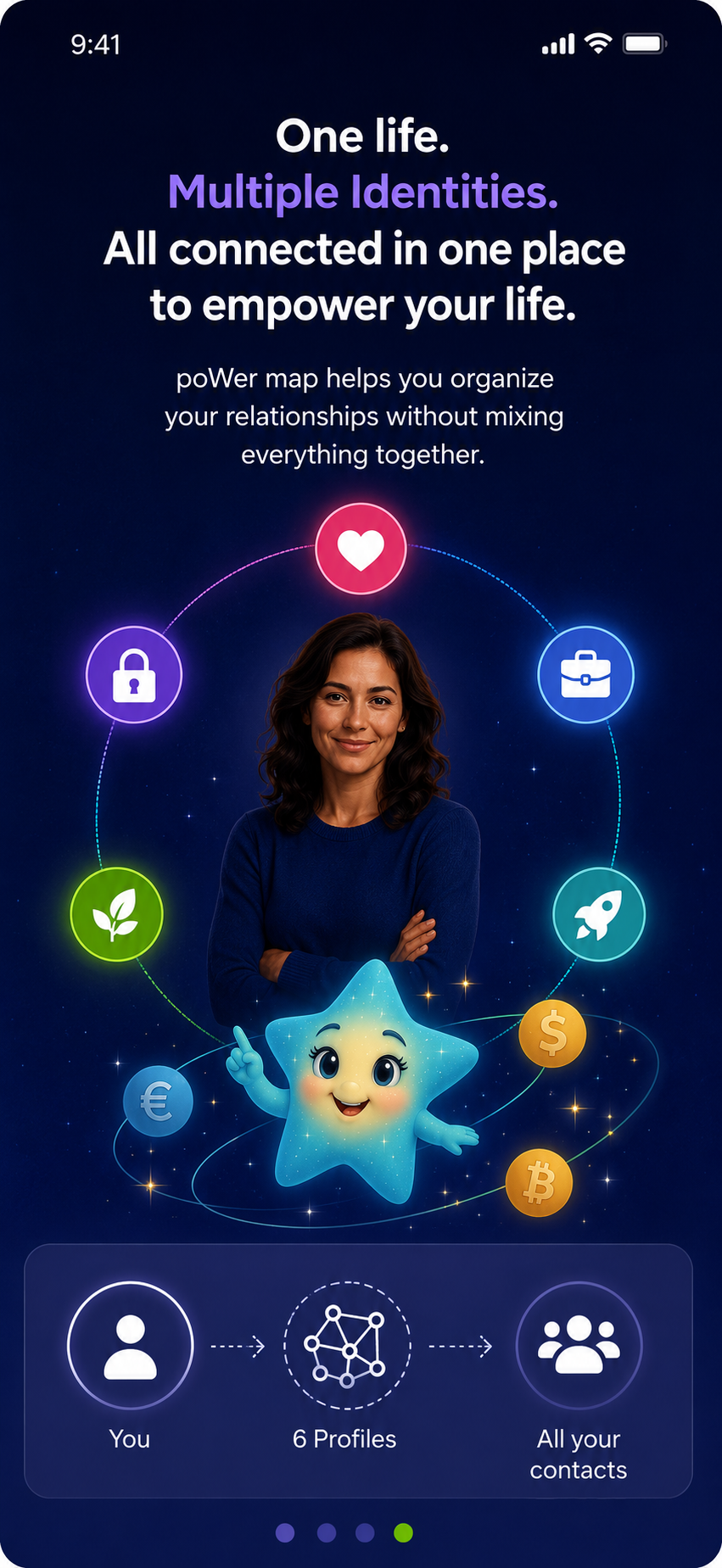
The result is the emergence of what can be called Identity Capital.
Identity Capital includes:
Networks sit at the center of all of them.
With our mobile app Power Map Contacts, organize your contacts, profiles, and identities in one app built for the multi-identity world.
Create personal, professional, or private profiles. Map your network. Take control of your personal brand.
Think about the most transformative opportunities in your life.
A new job.
A startup partnership.
An investment.
A speaking engagement.
A strategic introduction.
A life-changing recommendation.
Most did not emerge from a random follower.
Most emerged from a trusted relationship.
This is one of the great paradoxes of the digital era.
We spend enormous energy growing audiences.
Yet the highest-value opportunities often emerge from relatively small circles of trusted individuals.
In economic terms, weak attention is abundant.
Strong relationships are scarce.
Scarcity creates value.
Generation Alpha is growing up in a world where identities are fluid.
A teenager may simultaneously be:
For this generation, success will depend not merely on audience growth but on ecosystem building.
The winners may not be those with the largest followings.
They may be those with the strongest identity networks.
Relationships become infrastructure.
Financial capital creates financial returns.
Human capital creates productivity.
Identity Capital creates opportunity.
At the center of Identity Capital sits a powerful concept:
Relationship Capital.
Relationship Capital measures the value embedded within a network.
Not simply how many people you know.
But:
This may become one of the most important assets of the AI era.
Because while AI can generate content, it cannot automatically generate trust.
Trust remains human.
As networks grow, they become increasingly difficult to manage.
Contacts become fragmented.
Communities become disconnected.
Opportunities become invisible.
This challenge creates the need for a new category:
Identity Relationship Management (IRM).
CRM helped companies manage customers.
IRM helps individuals manage identities and networks.
The objective is simple:
Transform relationships into long-term strategic assets.
Not by collecting more contacts.
But by understanding the value already embedded within your network.
The internet taught us to measure followers.
The next decade may teach us to measure relationships.
Followers create visibility.
Networks create opportunity.
Followers generate attention.
Networks generate trust.
Followers can disappear overnight.
Networks compound for decades.
The most successful creators of the future may not be those who build the largest audiences.
They may be those who build the strongest relationship ecosystems.
Because in the emerging Identity Economy, your most valuable asset is not how many people follow you.
It is how many people trust you.


