
August 6, 2026
From stage names and alter egos to private circles and digital doubles, top performers have long understood the power of multiple identities. Discover why artists, athletes, and influencers are becoming pioneers of the emerging Identity Economy.

For decades, the world's most successful artists, athletes, and entertainers have been quietly using a strategy that most people barely notice.
They operate through multiple identities.
The public knows Lady Gaga.
But not everyone knows Stefani Germanotta.
The public knows The Weeknd.
But not everyone knows Abel Tesfaye.
Millions know MrBeast.
Far fewer know Jimmy Donaldson.
This phenomenon is not accidental.
It is strategic.
And as artificial intelligence, social media, and the Creator Economy continue to reshape the world of work, what was once a tactic used primarily by celebrities may soon become a necessity for everyone.
The future belongs to multi-identity individuals.
The first generation of creators built audiences.
The second generation built businesses.
The next generation is building identity ecosystems.
For years, success on social media was measured through simple metrics:
Today, those metrics are becoming less meaningful.
Artificial intelligence is dramatically increasing the amount of content being produced every day.
Content is becoming abundant.
Attention is becoming fragmented.
Algorithms are becoming increasingly unpredictable.
In this environment, creators need something more durable than content.
They need identity.
Historically, people operated through a single public identity.
One name.
One profession.
One reputation.
One network.
That model worked in a world where careers were linear.
Modern careers are not.
A successful influencer may simultaneously be:
An athlete may simultaneously be:
An artist may simultaneously be:
Each role attracts different audiences.
Each audience creates different opportunities.
Managing all of them through a single identity becomes increasingly difficult.
Organize your contacts, profiles, and personal brand in one app built for the new multi-identity economy.

Many people assume multiple identities create complexity.
The opposite is often true.
They create optionality.
A creator identity may attract sponsors.
An entrepreneur identity may attract investors.
An educator identity may attract students.
A speaker identity may attract conferences.
A community-builder identity may attract partnerships.
Each identity becomes a separate engine of opportunity.
The result is an expanding ecosystem rather than a single career path.
This is one reason why many of the world's most successful creators increasingly think like portfolio managers.
They manage portfolios of projects.
Portfolios of audiences.
And increasingly, portfolios of identities.
One of the least discussed challenges of visibility is exposure.
The more successful someone becomes, the more difficult it becomes to separate:
Many creators eventually discover that unlimited visibility comes with hidden costs.
Mental fatigue.
Security concerns.
Loss of privacy.
Relationship pressure.
Identity separation provides a solution.
Stage names, private communities, close-friend circles, pseudonyms, and digital doubles all serve the same purpose:
Creating strategic boundaries.
The goal is not secrecy.
The goal is control.
Athletes were once evaluated primarily by performance.
Today they are evaluated by influence.
A modern athlete is often expected to be:
Many athletes now generate significant income outside of sports.
Brand partnerships.
Content creation.
Speaking engagements.
Investments.
Business ventures.
As a result, they increasingly require multiple identities optimized for different audiences.
The athlete becomes only one identity among many.
For most of the twentieth century, financial capital dominated economic thinking.
The internet introduced a new form of value:
Attention Capital.
The AI era may introduce another:
Identity Capital.
Identity Capital includes:
Unlike followers, Identity Capital compounds.
Unlike algorithms, it remains portable.
Unlike platforms, it belongs to the individual.
This is why many creators are beginning to invest more in identity than audience growth.
Generation Alpha may become the first generation to view multiple identities as normal.
A teenager today may simultaneously be:
For them, identity is not singular.
It is modular.
Different communities.
Different audiences.
Different opportunities.
The celebrities and influencers building multiple identities today may simply be early adopters of a broader societal shift.
With our mobile app Power Map Contacts, organize your contacts, profiles, and identities in one app built for the multi-identity world.
Create personal, professional, or private profiles. Map your network. Take control of your personal brand.
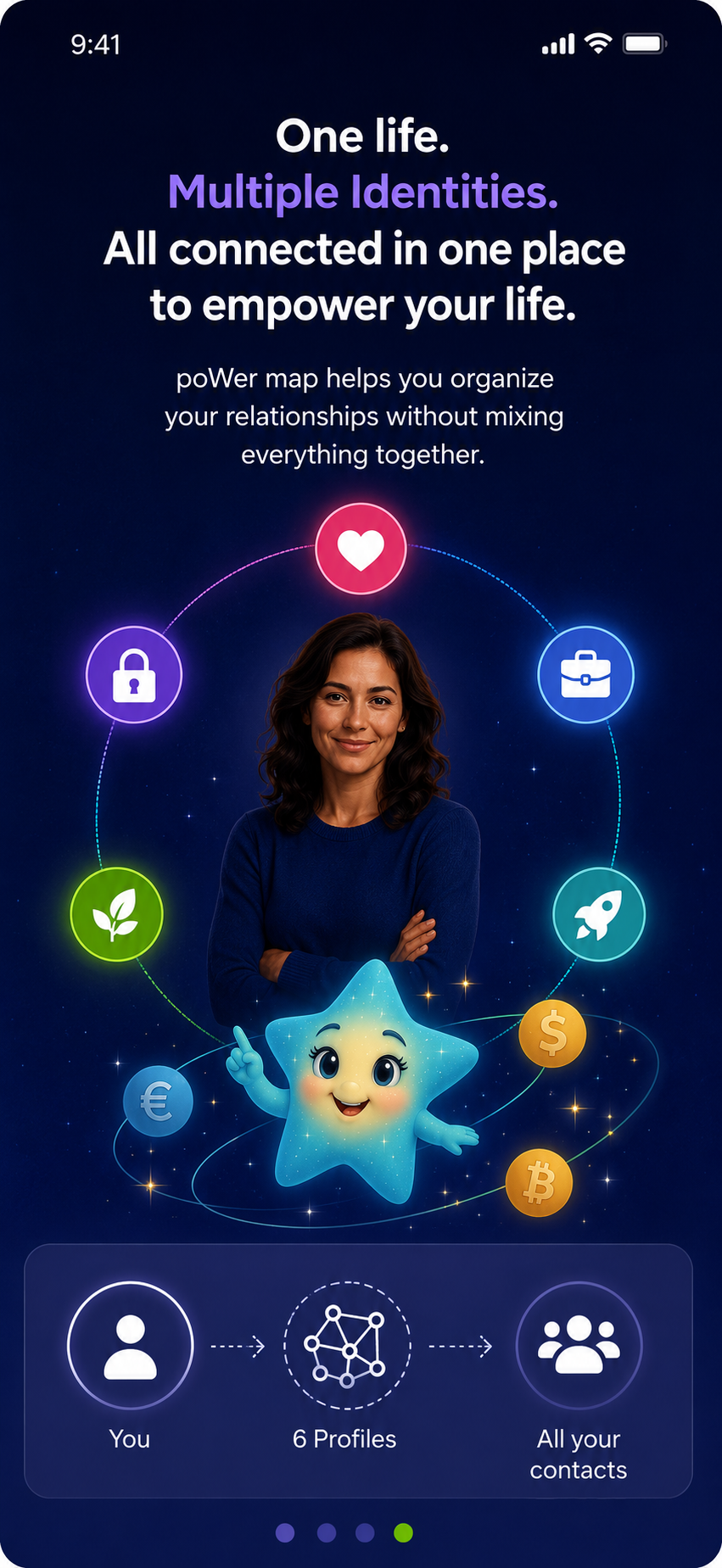
As identities become increasingly valuable, they require infrastructure.
This is where the digital double emerges.
A digital double is not a fake persona.
It is a structured representation of:
It becomes a living extension of an individual's identity.
A creator's digital double can:
In many cases, it may become more valuable than a traditional website or résumé.
The most important shift happening today is not technological.
It is sociological.
The internet initially rewarded publishers.
Social media rewarded creators.
Artificial intelligence may reward identity builders.
The creators who thrive over the next decade may not be those who publish the most content.
They may be those who build:
The game is changing.
From content creation to identity creation.
From audience growth to network growth.
From personal branding to identity ecosystems.
Artists and athletes are often viewed as exceptional cases.
In reality, they are early indicators.
They are showing the rest of society how to navigate a world where:
The lesson is simple.
Your future may not be defined by a single brand.
It may be defined by your ability to manage multiple identities simultaneously.
The world's most successful artists, athletes, and influencers are not simply building audiences.
They are building identity portfolios.
They understand that followers fluctuate.
Platforms change.
Algorithms evolve.
But identity endures.
As AI makes content abundant and competition intensifies, identity is emerging as one of the most valuable assets an individual can own.
The future belongs not to those with the most followers.
But to those who can successfully build, manage, and grow multiple identities across multiple communities.
Because in the emerging Identity Economy, one person may no longer have one identity.
One person may become an ecosystem.


