
August 6, 2026
From stage names to digital doubles, top creators have always separated their public and private lives. Discover why privacy, identity management, and reputation control are becoming essential skills in the age of AI and the Identity Economy.

For most of human history, privacy happened by default.
If someone wanted to know where you lived, who your friends were, what you believed, or how you spent your time, they had to make a significant effort.
The internet changed that.
Social media accelerated it.
Artificial intelligence is now amplifying it.
Today, a creator can build an audience of millions from a smartphone.
But that same visibility creates a new challenge:
How do you remain public without becoming completely exposed?
The most successful creators, artists, athletes, entrepreneurs, and public figures have spent decades solving this problem.
Their solution is surprisingly simple.
They separate identities.
And in the emerging Identity Economy, identity separation may become one of the most important skills anyone can develop.
Long before Instagram, TikTok, or YouTube existed, artists understood the power of identity management.
The public knew:
But those names were never the entire story.
Behind every public persona existed a private individual.
The stage name was not simply a branding tool.
It was a protective layer.
It created distance between:
The world's most famous creators understood something that the internet is only beginning to rediscover:
visibility and privacy are not opposites.
The most successful public figures learn how to balance both.
Organize your contacts, profiles, and personal brand in one app built for the new multi-identity economy.

Most creators begin their journey seeking visibility.
Visibility creates growth.
Growth creates opportunities.
Opportunities create income.
But eventually visibility creates a paradox.
The larger the audience becomes, the more valuable privacy becomes.
A creator with 500 followers rarely worries about personal security.
A creator with 5 million followers often thinks about it every day.
Family members become visible.
Personal relationships become visible.
Locations become visible.
Routines become visible.
The same exposure that creates opportunity can also create vulnerability.
This is why many successful creators eventually invest more energy into protecting their private lives than growing their audiences.
Most social platforms were designed around a simplistic idea:
one account,
one profile,
one identity.
Real life does not work this way.
A creator may simultaneously be:
Each role exists within a different social context.
Each role requires different boundaries.
Yet most digital platforms collapse these identities into a single public profile.
The result is identity collision.
Professional contacts meet personal contacts.
Business relationships meet family relationships.
Public visibility meets private life.
The larger the audience becomes, the harder these collisions become to manage.
Many people assume identity separation is about hiding.
In reality, it is often about freedom.
When public and private identities are separated, individuals gain more control over how they participate in different environments.
They can:
Identity separation is not deception.
It is context management.
Just as we behave differently at work, at home, and among friends, creators increasingly require different spaces for different aspects of their lives.
The next generation of creators may not operate under a single public identity at all.
A creator may simultaneously maintain identities as:
Each identity attracts a different audience.
Each audience creates different opportunities.
Each opportunity generates different relationships.
The future creator increasingly resembles a portfolio rather than a single brand.
This is one reason the Creator Economy is gradually evolving into the Identity Economy.
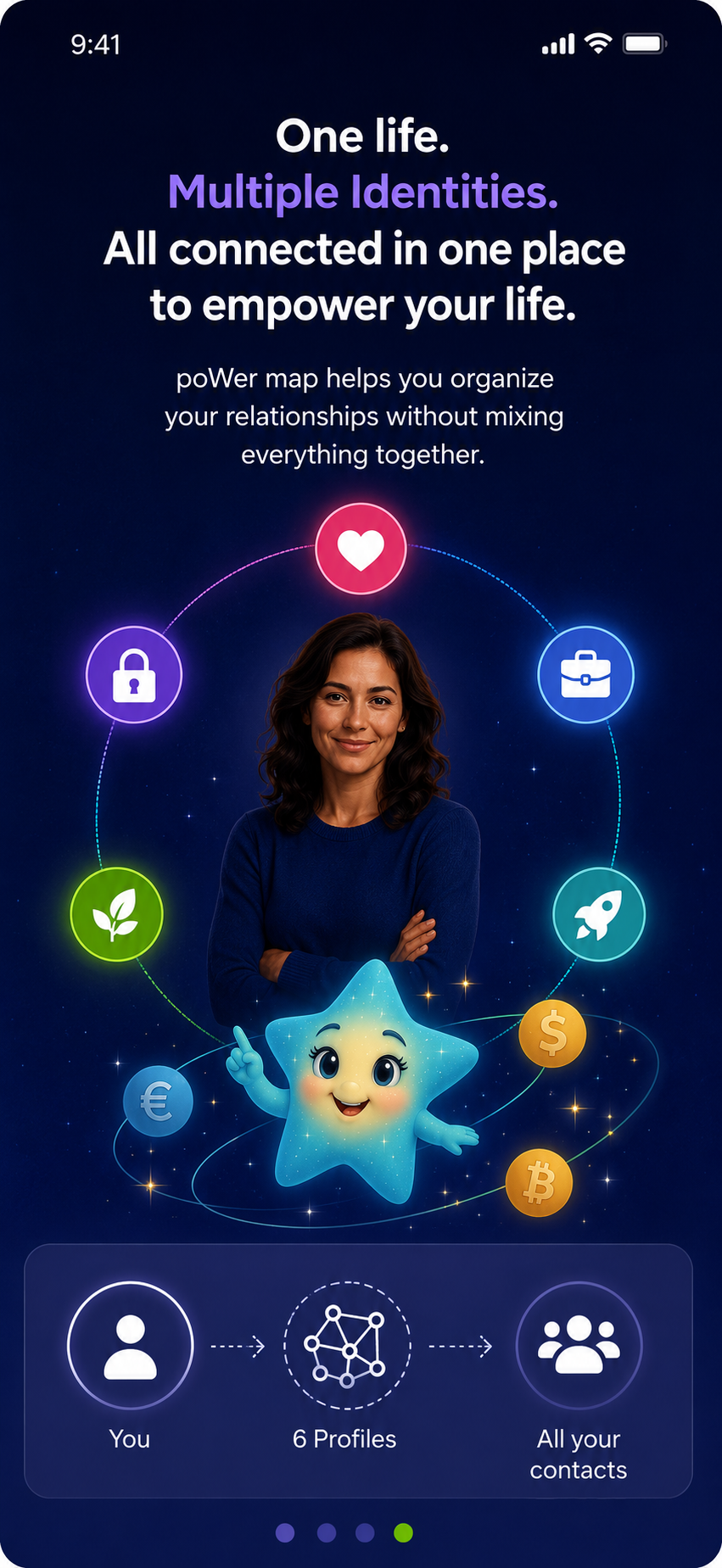
With our mobile app Power Map Contacts, organize your contacts, profiles, and identities in one app built for the multi-identity world.
Create personal, professional, or private profiles. Map your network. Take control of your personal brand.
Artificial intelligence is dramatically reducing the cost of content creation.
Articles can be generated.
Videos can be generated.
Images can be generated.
Music can be generated.
Content is becoming abundant.
When abundance increases, scarcity becomes more valuable.
The scarce resource is no longer content.
The scarce resource is trust.
Trust is attached to identity.
People trust people.
People trust reputations.
People trust communities.
As AI-generated content becomes increasingly common, the identity behind the content becomes increasingly important.
This makes identity management a strategic capability.
Not merely a personal one.
As creators accumulate audiences, projects, communities, and opportunities, they need a better way to organize their identity.
This is where the concept of the digital double emerges.
A digital double is not a fictional avatar.
It is a structured representation of:
It becomes an extension of the creator.
A digital presence that remains active, discoverable, and valuable even when the creator is offline.
In many cases, it becomes the first version of the creator that others encounter.
Before a meeting.
Before a collaboration.
Before an investment.
Before a partnership.
The digital double becomes a strategic asset.
Historically, infrastructure meant roads, factories, and physical assets.
In the digital economy, reputation increasingly functions as infrastructure.
It accelerates trust.
It reduces friction.
It attracts opportunities.
The creators who manage their reputations intentionally often outperform those who focus exclusively on audience growth.
Because opportunities rarely emerge from attention alone.
They emerge from trust.
And trust compounds over time.
Many creators initially separate their public and private lives for practical reasons.
To reduce exposure.
To protect family.
To preserve mental well-being.
Over time, however, identity management becomes something larger.
It becomes a source of competitive advantage.
The ability to organize identities, protect privacy, manage relationships, and cultivate reputation creates what can be called Identity Capital.
Identity Capital includes:
These assets increasingly influence access to opportunities.
And unlike algorithms, they compound.
As creators become multi-identity individuals, they accumulate increasingly complex networks.
Followers.
Sponsors.
Partners.
Investors.
Mentors.
Friends.
Collaborators.
The challenge is no longer audience growth.
The challenge is relationship management.
This is where Identity Relationship Management (IRM) becomes relevant.
CRM transformed how companies manage customer relationships.
IRM helps individuals manage the relationships attached to multiple identities.
It transforms contacts into strategic assets.
It transforms networks into opportunity ecosystems.
The most successful creators of the next decade may not be those who achieve the greatest visibility.
They may be those who maintain the greatest control.
Control over their identity.
Control over their privacy.
Control over their relationships.
Control over their reputation.
Artists understood this decades ago through stage names.
Influencers are rediscovering it through personal branding.
Future creators may extend it through digital doubles and Identity Relationship Management.
Because in the emerging Identity Economy, the challenge is no longer becoming visible.
The challenge is deciding which parts of yourself should remain visible—and which parts should remain your own.


