
August 6, 2026
Artists, creators, entrepreneurs, and professionals are increasingly living through multiple identities. Discover why the Multi-Identity Economy is emerging and how reputation, networks, and digital personas may become the most valuable assets of the AI era.
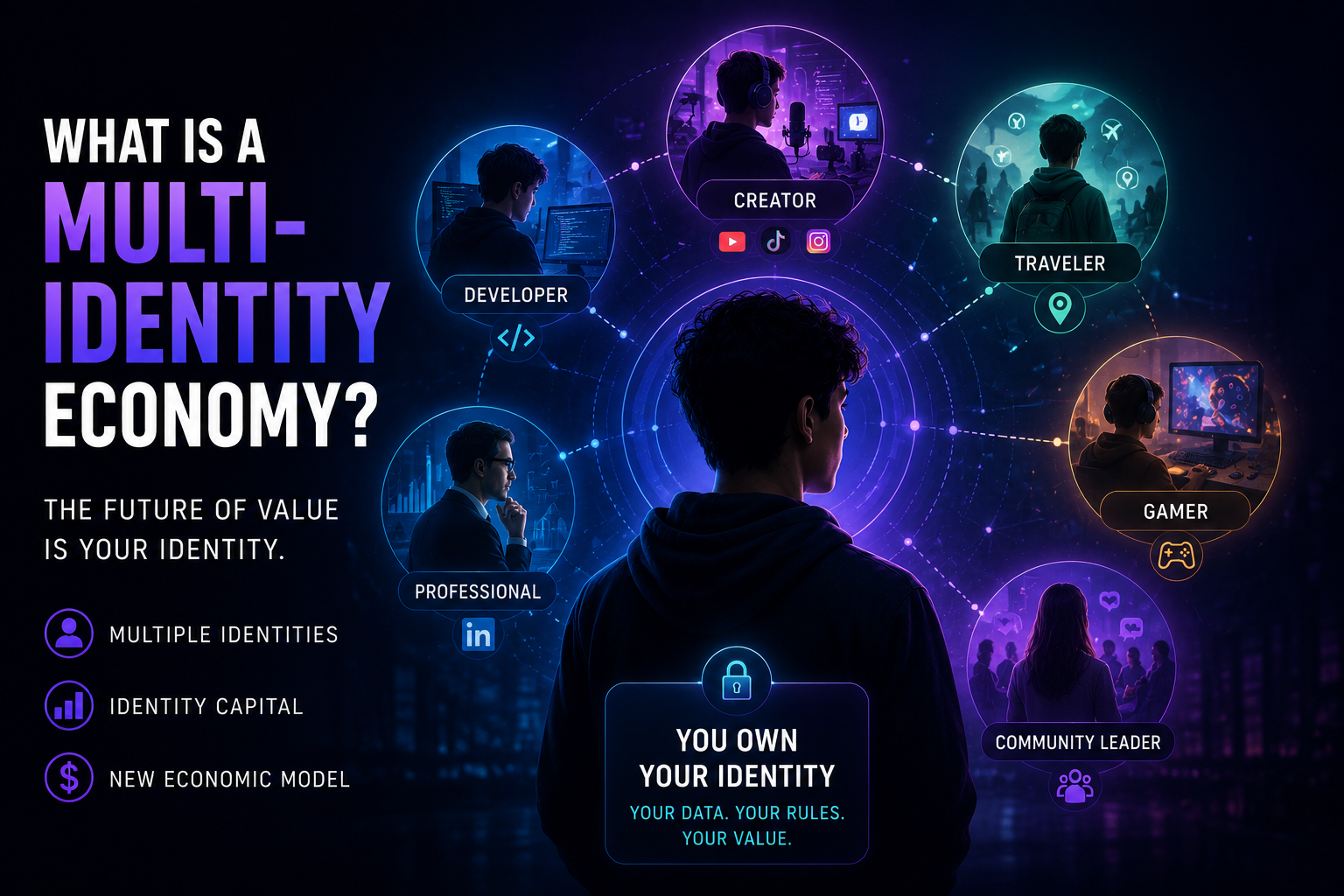
For most of human history, identity was simple.
You were born into a family.
You joined a community.
You learned a profession.
You built a reputation.
For centuries, people typically operated under a single public identity.
Today, that model is rapidly disappearing.
A growing number of people now maintain multiple identities across different communities, platforms, professions, and social environments.
You may be:
Each identity has its own audience.
Each identity has its own reputation.
Each identity has its own opportunities.
This transformation is giving rise to what we can call the Multi-Identity Economy.
For previous generations, identity was largely tied to physical life.
Your school knew you.
Your employer knew you.
Your neighbors knew you.
Most relationships existed in the same environment.
The internet changed that.
Social media accelerated it.
Artificial intelligence is now amplifying it.
Today, individuals can simultaneously participate in dozens of communities while presenting different aspects of themselves in each one.
Identity has become modular.
And increasingly, identity is becoming an economic asset.
Long before social media existed, artists understood the power of identity.
Millions know Lady Gaga.
Few know Stefani Germanotta.
Millions know Eminem.
Few know Marshall Mathers.
Millions know The Weeknd.
Few know Abel Tesfaye.
Artists have used stage names for decades to:
What was once a strategy reserved for celebrities is now becoming accessible to everyone.
The artist economy is becoming the mainstream economy.
Organize your contacts, profiles, and personal brand in one app built for the new multi-identity economy.

Artificial intelligence is dramatically lowering the barriers to creation.
Today, anyone can create:
The result is a massive expansion of personal brands.
Millions of people who would never have considered themselves creators are now producing content.
Some create under their real names.
Others create under pseudonyms.
Some maintain multiple creator brands simultaneously.
In many cases, individuals are beginning to manage several digital identities at the same time.
Generation Alpha may become the first generation for whom multiple identities are completely normal.
A teenager could simultaneously be:
Each role creates relationships.
Each role develops reputation.
Each role generates opportunities.
Future generations may not think in terms of a single identity.
They may think in terms of identity portfolios.
Traditionally, wealth has been associated with:
The Multi-Identity Economy introduces another category:
Identity Capital.
Identity Capital includes:
In many industries, these assets already influence income and opportunity.
A creator with a trusted audience can launch products.
A consultant with a strong reputation can attract clients.
An entrepreneur with a powerful network can access investors.
Identity is no longer simply personal.
It is increasingly economic.
As identities multiply, so do relationships.
Managing those relationships becomes more complex.
This challenge is giving rise to a new discipline:
Identity Relationship Management (IRM).
IRM focuses on helping individuals:
In many ways, IRM may become for individuals what CRM became for companies.
A framework for managing one of their most valuable assets.
Their identity ecosystem.
The Multi-Identity Economy creates opportunities.
But it also creates risks.
More identities can mean:
Artificial intelligence introduces additional challenges.
Deepfakes, fake profiles, and synthetic personalities may make it increasingly difficult to distinguish authentic identities from artificial ones.
Trust will become one of the defining challenges of the next decade.
The future requires a balance between:
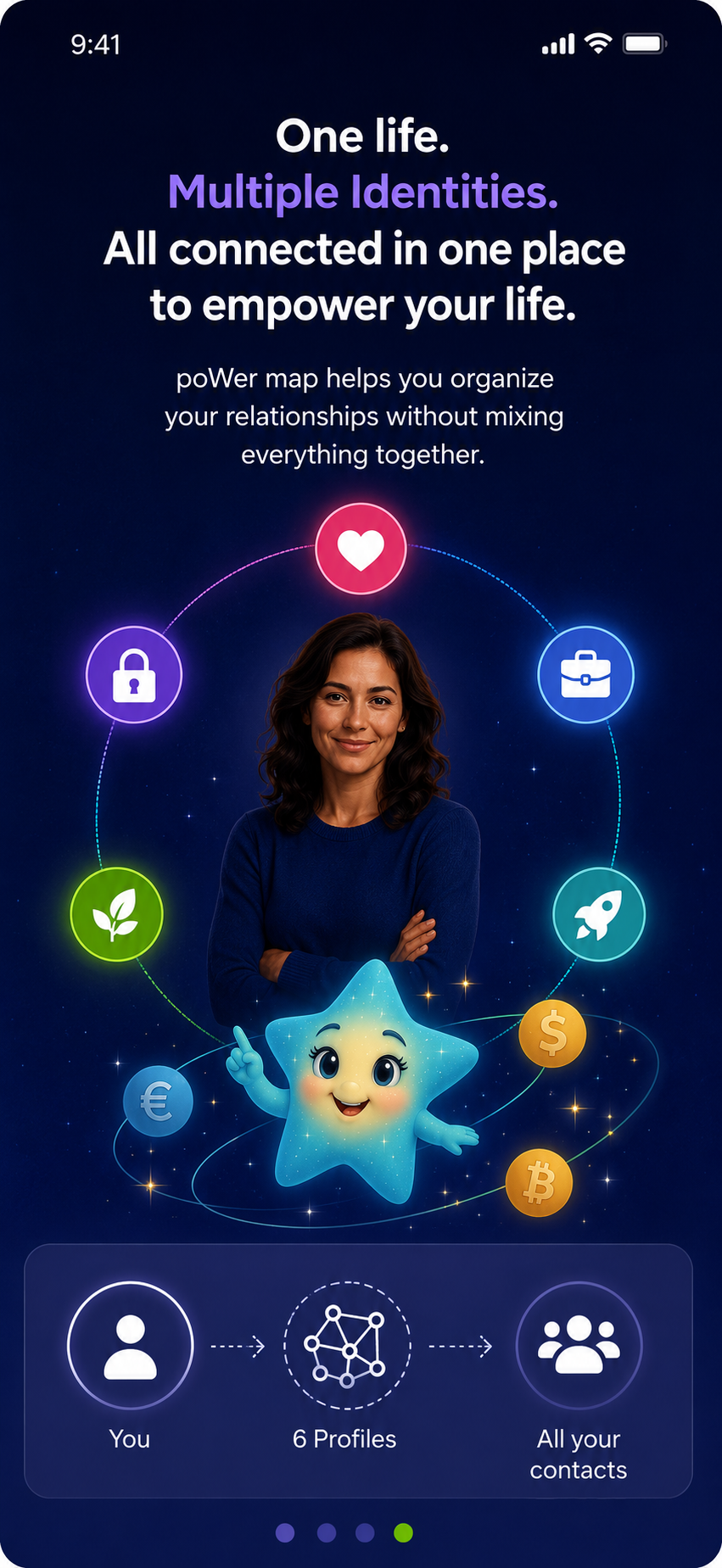
With our mobile app Power Map Contacts, organize your contacts, profiles, and identities in one app built for the multi-identity world.
Create personal, professional, or private profiles. Map your network. Take control of your personal brand.
If identity is becoming a form of capital, an obvious question follows:
Can identity generate income?
For decades, the digital economy has operated according to a simple model.
Platforms collect data.
Platforms monetize data.
Users receive services in exchange.
In practice, billions of people have been generating economic value through their personal information without directly participating in that value creation.
The Multi-Identity Economy may challenge this model.
If reputation, audience, skills, experience, opinions, preferences, health metrics, behavioral patterns, and social relationships contribute to economic value, why shouldn't individuals have greater control over how those assets are used?
Tomorrow, people may increasingly choose to manage their personal data as they manage financial assets.
Instead of automatically surrendering data, they may decide:
In this future, personal data is no longer a by-product.
It becomes an asset class.
A creator may license audience insights.
A professional may monetize verified expertise.
An athlete may share performance metrics.
A patient may contribute health data to medical research.
A consumer may choose to rent access to purchasing preferences.
The principle remains the same:
the individual remains the owner.
The value is not limited to a single identity.
It extends across the entire identity portfolio.
Professional identity.
Creator identity.
Entrepreneurial identity.
Community identity.
Personal identity.
Together, these identities continuously generate information, reputation, and trust.
The Multi-Identity Economy is therefore not only about managing multiple identities.
It is about giving individuals greater ownership, control, and potentially economic participation in the value created by those identities.
For the first time in the history of the internet, people may move from being the product to becoming the asset manager.
Not merely users of digital platforms.
But active participants in the economy generated by their own identities.
The Multi-Identity Economy is not a distant future.
It is already emerging.
Artists pioneered it.
Creators accelerated it.
Artificial intelligence is scaling it.
Generation Alpha will normalize it.
In the coming years, people may no longer be defined by a single profession, community, or reputation.
Instead, they will manage portfolios of identities connected to different audiences, opportunities, and networks.
The question is no longer whether people will have multiple identities.
The question is how effectively they will manage them.
Because in the age of AI, your most valuable asset may not be what you own.
It may be who you are across every identity you choose to build.


