
August 6, 2026
AI is making content abundant and easy to create. Discover why trust, reputation, networks, and Identity Capital may become the true sources of value in the next evolution of the Creator Economy.

For nearly two decades, the Creator Economy has been one of the defining stories of the internet.
Platforms such as YouTube, Instagram, TikTok, Twitch, Patreon, and Substack enabled millions of individuals to monetize content directly.
For the first time in history, a teenager with a smartphone could potentially build an audience larger than a traditional media company.
The Creator Economy democratized distribution.
It democratized attention.
And it democratized entrepreneurship.
But a deeper shift is now emerging.
The next phase of the internet may not be defined by creators.
It may be defined by identities.
The Creator Economy is becoming the Identity Economy.
The Creator Economy was built on a relatively simple proposition.
Create content.
Build an audience.
Monetize attention.
The model worked because distribution was scarce.
Traditional media companies controlled access to audiences.
Digital platforms removed those barriers.
Suddenly, creators could monetize:
The creator became the business.
But beneath the surface, something more important was happening.
The real asset was never the content.
The real asset was the identity behind the content.
Organize your contacts, profiles, and personal brand in one app built for the new multi-identity economy.

Artificial intelligence is dramatically changing the economics of creation.
For most of human history, content creation required significant effort.
Writing required expertise.
Video production required equipment.
Graphic design required specialized skills.
Music production required studios.
Today, AI is lowering those barriers.
A single individual can generate:
at a scale that would have required entire teams just a few years ago.
Content is becoming abundant.
Abundance changes value.
Historically, when something becomes abundant, another layer becomes scarce.
That scarce layer is increasingly identity.
When content becomes infinite, people stop asking:
"Can this be created?"
Instead, they ask:
"Can this be trusted?"
Trust has always been valuable.
In an AI-driven world, it becomes critical.
Consider two identical pieces of content.
One is published by an unknown source.
The other is published by someone you have followed and trusted for years.
The information may be identical.
The trust is not.
This is why identity is becoming economically valuable.
Identity provides context.
Identity provides credibility.
Identity provides meaning.
Identity provides trust.
The first generation of creators focused on audience growth.
Followers became the primary metric.
Subscribers became the primary objective.
Reach became the primary currency.
The next generation may focus on something different:
Identity Capital.
Identity Capital includes:
Audience size remains important.
But audience size alone is increasingly insufficient.
A creator with 50,000 highly engaged followers may possess more economic leverage than someone with a million passive followers.
Identity Capital explains why.
The first generation of creators often built a single public identity.
The next generation may operate through multiple identities simultaneously.
A single individual may be:
Each identity attracts a different audience.
Each audience generates different opportunities.
Each opportunity compounds over time.
The result is a new phenomenon:
the Multi-Identity Creator.
Creators are no longer building audiences.
They are building ecosystems.
Generation Alpha is growing up in a fundamentally different environment.
Many young people already maintain distinct identities across:
For them, multiple identities are not unusual.
They are normal.
The traditional idea of a single professional identity may appear increasingly outdated.
Future creators may manage portfolios of identities rather than a single personal brand.
With our mobile app Power Map Contacts, organize your contacts, profiles, and identities in one app built for the multi-identity world.
Create personal, professional, or private profiles. Map your network. Take control of your personal brand.
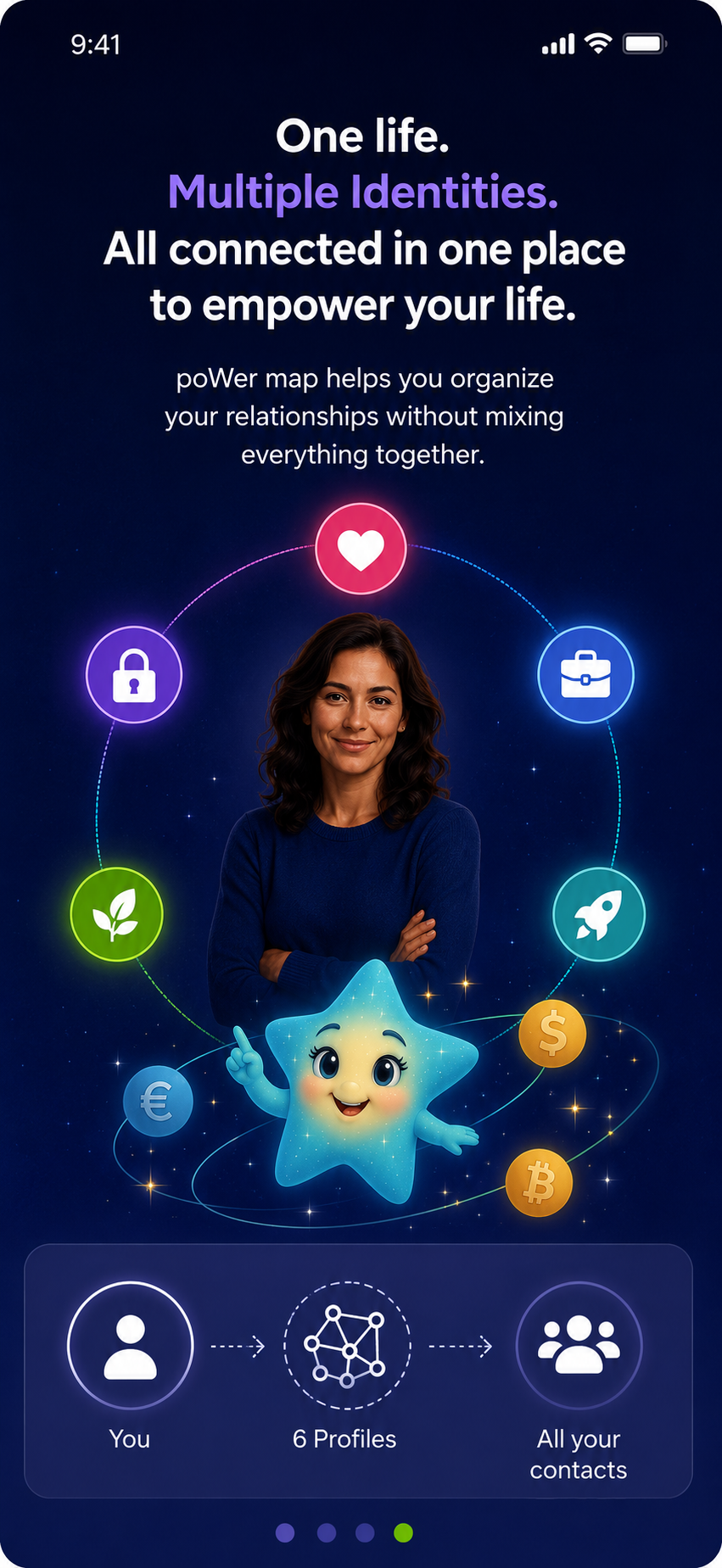
As identities multiply, they require management.
This is where the concept of the digital double emerges.
A digital double is not a fictional avatar.
It is a structured representation of:
Over time, the digital double becomes an extension of the individual.
It works while its owner sleeps.
It creates opportunities.
It builds discoverability.
It accumulates trust.
It becomes a living asset.
In many cases, it may be encountered before the person behind it.
The most important opportunities rarely come from algorithms.
They come from relationships.
Historically, creators focused on audience building.
The next generation may focus on network building.
The difference is significant.
Audiences consume.
Networks collaborate.
Audiences watch.
Networks create opportunities.
Audiences generate views.
Networks generate careers.
As content becomes increasingly automated, relationships become increasingly valuable.
This is why social capital is moving to the center of economic value creation.
If identities become assets, they require management.
Customer Relationship Management transformed companies by helping them organize customer relationships.
The Identity Economy requires something similar.
Identity Relationship Management (IRM) focuses on:
In a world where individuals operate multiple identities simultaneously, managing contacts is no longer enough.
Managing identity ecosystems becomes essential.
The first internet rewarded publishers.
The second internet rewarded creators.
The next internet may reward identity builders.
The individuals who thrive will not necessarily be those who produce the most content.
They may be those who build:
Content will remain important.
But content increasingly becomes a commodity.
Identity becomes the differentiator.
The Creator Economy was never really about content.
It was about individuals gaining direct access to audiences.
Artificial intelligence is now pushing that evolution further.
As content becomes abundant, identity becomes scarce.
As creation becomes automated, trust becomes valuable.
As audiences fragment, relationships become strategic.
The next decade may belong not to those who create the most.
But to those who build the strongest Identity Capital.
Because in the emerging Identity Economy, your most valuable asset is no longer the content you publish.
It is the identity people choose to trust.


