
August 6, 2026
The Monsanto power map controversy revealed the dark side of influence mapping: when stakeholder intelligence becomes opaque, intrusive, and disconnected from consent. This article explains what happened, why it matters, and how ethical relationship intelligence can help organizations build trust instead of manipulating influence.

Power mapping is one of the most powerful tools in strategy, public affairs, sales, advocacy, and business development.
Used well, it helps organizations understand ecosystems, identify decision-makers, map relationships, anticipate risks, and engage stakeholders with relevance and respect.
Used badly, it can become something else entirely: a surveillance tool, a manipulation framework, or a hidden database of people categorized without their knowledge.
The Monsanto controversy is one of the clearest examples of this ethical tension.
It is a case that goes far beyond one company, one industry, or one lobbying campaign. It raises a deeper question for every organization that maps people, influence, networks, or relationships:
Where is the line between strategic intelligence and unethical profiling?
That question matters more than ever.
In a world where professionals, companies, platforms, and institutions collect more relationship data than ever before, the future of relationship intelligence will depend not only on technology, but on trust.
Organize your contacts, profiles, and personal brand in one app built for the new multi-identity economy.

In 2019, investigative reporting revealed that a database had been created in France as part of Monsanto’s campaign around glyphosate, the active ingredient in Roundup.
The file reportedly included politicians, journalists, scientists, public officials, agricultural representatives, activists, and other influential figures involved in the public debate on glyphosate, pesticides, and genetically modified organisms.
These individuals were not simply listed by name. They were reportedly categorized according to their perceived position, influence, credibility, and relevance to the debate.
In other words, this was not a basic contact list.
It was a stakeholder map.
It was a power map.
The goal of such a tool is typically to identify who matters, how they are positioned, how influential they are, and how an organization might engage with them.
In theory, stakeholder mapping can be legitimate. Governments, NGOs, corporations, campaigns, consulting firms, and advocacy groups all use some form of influence mapping to understand their environment.
But in this case, the controversy came from several critical issues:
The people included in the database said they had not been informed.
The file reportedly contained personal and opinion-based information.
The mapping was linked to a highly sensitive public health and environmental debate.
The purpose was connected to lobbying and influence.
The individuals profiled included journalists and scientists, whose independence is essential to public debate.
That combination turned a strategic mapping exercise into a major controversy.
The Monsanto case matters because it reveals the uncomfortable power of relationship data.
A single contact may not seem sensitive.
A job title may look harmless.
A public opinion may appear easy to classify.
A stakeholder score may feel like a practical business tool.
But when these elements are combined, they can create a powerful influence profile.
Who is favorable?
Who is skeptical?
Who is influential?
Who should be approached?
Who should be neutralized?
Who can shape public opinion?
Who can influence regulation?
This is where contact management becomes something much more strategic.
The more structured the data becomes, the more power it creates.
And with power comes responsibility.
The Monsanto controversy shows that stakeholder intelligence cannot be treated as a neutral administrative exercise. It can affect reputations, democratic debate, scientific independence, journalism, regulatory processes, and public trust.
That is why ethical boundaries matter.
It would be too easy to conclude that power mapping itself is the problem.
It is not.
Stakeholder mapping is a legitimate and often necessary practice.
A nonprofit organization may map stakeholders to defend a public cause.
A startup may map investors, advisors, customers, and partners.
A consulting firm may map decision-makers in a complex transformation program.
A sales team may map buying committees to understand who influences a deal.
A public affairs team may map institutions to contribute to a regulatory debate.
A recruiter may map talent communities to identify future candidates.
In all these cases, mapping relationships can create clarity.
The problem is not the map.
The problem is how the map is built, what data it contains, how people are categorized, whether they know about it, whether the data is fair, whether it is lawful, and how the organization intends to use it.
A map can help build trust.
Or it can help manipulate trust.
That difference is not technical. It is ethical.
Every organization needs to understand its ecosystem.
But understanding influence is not the same as manipulating influence.
Ethical influence mapping asks:
Who are the stakeholders?
What are their legitimate interests?
What information do they need?
How can we engage them transparently?
How can we build trust over time?
How can we respect their independence?
Unethical influence mapping asks something very different:
Who supports us?
Who opposes us?
Who can be pressured?
Who can be discredited?
Who can be used as a proxy?
Who can influence the debate without appearing connected to us?
The first approach creates relationship intelligence.
The second creates reputational risk.
The Monsanto controversy became so sensitive because it appeared to sit on the wrong side of that line. It was not simply about knowing stakeholders. It was about categorizing people in a controversial public debate without the level of transparency and consent expected in a democratic society.
That is why the case continues to be relevant.
It is not only a story about Monsanto. It is a warning for every organization that uses data to understand people.
The Monsanto power map controversy highlights five major lessons about data ethics.
A common misconception is that if information is public, it can be freely collected, scored, combined, and used for strategic purposes.
That is not always true.
A journalist’s article may be public.
A scientist’s research may be public.
A politician’s statement may be public.
An activist’s position may be public.
But turning these elements into a private influence database can create a new form of data processing.
The ethical question is not only whether the information exists publicly.
The real question is:
What are you doing with it?
Are you storing it?
Are you scoring it?
Are you inferring political opinions?
Are you sharing it with third parties?
Are you using it to influence public debate?
Are you informing the people concerned?
Are you giving them rights over the data?
In modern relationship intelligence, context matters as much as content.
The moment an organization starts scoring people, the stakes become higher.
A score can appear objective, but it often reflects subjective judgments.
Influence score.
Credibility score.
Support score.
Opposition score.
Risk score.
Openness score.
These ratings can shape how people are approached, ignored, targeted, or excluded.
That is why scoring people must be handled with extreme care.
In business development, a score can help prioritize outreach.
In lobbying, a score can influence political strategy.
In recruiting, a score can shape career opportunities.
In public affairs, a score can shape reputation campaigns.
A poorly governed scoring system can become a hidden decision engine.
This is why transparency, explainability, and human accountability are essential.
Stakeholder mapping often includes opinions.
A person may be considered favorable, neutral, skeptical, hostile, open-minded, influential, or undecided.
But opinions about politics, public policy, health, science, agriculture, climate, or social issues can be sensitive.
When organizations collect or infer opinions, they are no longer managing basic contact data. They are entering a much more sensitive territory.
The Monsanto case shows how quickly a stakeholder map can become controversial when it classifies people according to their perceived views on a public issue.
For relationship intelligence platforms, this is a major lesson.
The future of professional mapping must be built around clear boundaries:
Do not collect more than necessary.
Do not infer sensitive views without a legitimate reason.
Do not hide the existence of sensitive profiling.
Do not use relationship data to pressure or discredit people.
Do not confuse strategic relevance with permission.
Influence mapping is often designed to protect an organization’s interests.
But when it is done poorly, it can produce the opposite effect.
The Monsanto case became a reputational issue because it created a perception of hidden surveillance, not open engagement.
That perception is extremely damaging.
Once stakeholders believe they are being profiled, scored, or monitored without transparency, trust disappears.
Journalists become more suspicious.
Scientists become more defensive.
Regulators become more cautious.
The public becomes more skeptical.
Employees become uncomfortable.
Partners become exposed.
In strategic terms, the cost of unethical mapping can be far greater than the benefit of the intelligence collected.
A power map that destroys trust is not a strategic asset.
It is a liability.
The future of relationship intelligence cannot be built only on features.
It must be built on governance.
Who can create maps?
What data can be collected?
Who can access the data?
How long is it stored?
What categories are prohibited?
What consent or information is required?
How can people correct or delete data?
How are sensitive attributes handled?
How are exports controlled?
How are third-party agencies supervised?
These are not secondary questions.
They are the foundation of responsible relationship intelligence.
The Monsanto case illustrates what happens when the governance of influence data becomes unclear, insufficient, or invisible.
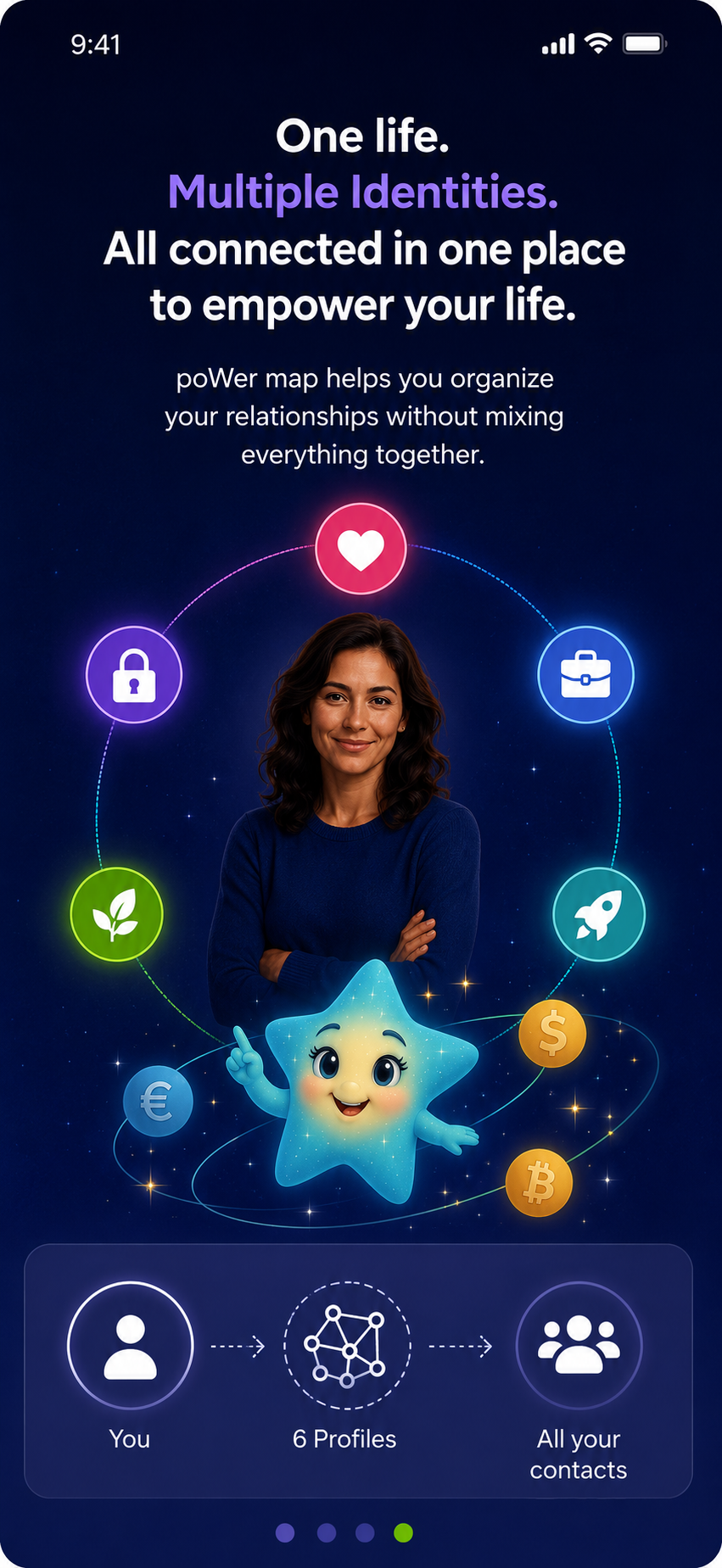
With our mobile app Power Map Contacts, organize your contacts, profiles, and identities in one app built for the multi-identity world.
Create personal, professional, or private profiles. Map your network. Take control of your personal brand.
The lesson is not to stop mapping relationships.
The lesson is to map relationships responsibly.
Ethical power mapping should follow seven principles.
Every map should have a legitimate and clearly defined purpose.
Are you mapping a sales opportunity?
A project ecosystem?
A stakeholder consultation?
A recruiting network?
A partnership landscape?
A professional community?
If the purpose is vague, the risk increases.
A good power map starts with a clear question.
A bad power map starts with unlimited curiosity.
Collect only the data you need.
Relationship intelligence does not require collecting everything about everyone.
In many cases, a role, organization, relationship context, and interaction history may be enough.
The more sensitive the data, the stronger the justification must be.
Whenever possible, people should understand how their data is used.
This is especially important when the data is not merely stored, but analyzed, scored, shared, or used to drive decisions.
Transparency does not weaken strategy.
It strengthens trust.
Some stakeholders require special protection because their independence is central to public life.
Journalists.
Scientists.
Regulators.
Judges.
Public officials.
Civil society leaders.
Mapping these actors is not the same as mapping commercial prospects.
The more a person contributes to public debate, science, or democratic oversight, the more careful organizations must be.
Power maps should never become automatic engines of judgment.
A map can support thinking.
It should not replace thinking.
Scores, categories, and labels must remain open to review, correction, and challenge.
Stakeholder maps can be highly sensitive.
They should not be stored in unsecured spreadsheets, shared casually, or exported without control.
Relationship data is strategic data.
It deserves strategic protection.
The final question is the most important one:
What will the organization do with the map?
If the goal is to understand, listen, engage, and build trust, mapping can be constructive.
If the goal is to manipulate, intimidate, pressure, or discredit, mapping becomes dangerous.
Technology cannot answer this question alone.
Leadership must.
At Power Map, we believe that relationship intelligence is one of the most important categories of the future.
Professionals need better tools to manage their contacts, networks, identities, skills, and opportunities.
Companies need better ways to understand their relationship capital.
Consultants, sales leaders, recruiters, advisors, solopreneurs, and executives need better ways to organize the people who matter in their professional lives.
But the Monsanto controversy is a reminder that this category must be built carefully.
A relationship intelligence platform should not encourage hidden manipulation.
It should help users create clarity, context, trust, and opportunity.
It should help people structure their networks without violating the dignity, privacy, or independence of others.
It should make relationships more meaningful, not more extractive.
This is the difference between ethical relationship intelligence and opaque influence engineering.
Traditional power mapping often focuses on influence.
Who has power?
Who can block?
Who can accelerate?
Who must be convinced?
Who controls the decision?
Relationship intelligence goes further.
It asks:
What is the quality of the relationship?
What is the history of trust?
What is the context?
What value can be created for both sides?
What is the right moment to engage?
What is the respectful way to reconnect?
What should remain private?
What should never be used?
This distinction is essential.
Power mapping can become transactional.
Relationship intelligence should be relational.
Power mapping can focus on control.
Relationship intelligence should focus on trust.
Power mapping can reduce people to positions.
Relationship intelligence should preserve context, nuance, and respect.
The Monsanto controversy does not prove that power mapping is bad.
It proves that power mapping without ethics is dangerous.
It shows that stakeholder intelligence can become harmful when it lacks transparency, proportionality, consent, governance, and respect for people’s independence.
It also shows that the tools organizations use to understand their environment can shape the way they behave.
If a map turns people into targets, the organization will behave accordingly.
If a map helps people understand relationships, create value, and engage responsibly, the organization can build trust.
The future will require more mapping, not less.
But it will also require better rules, better tools, and better intentions.
The Monsanto power map controversy remains a powerful case study because it sits at the intersection of influence, lobbying, data protection, public debate, and corporate responsibility.
It reminds us that relationship data is never just data.
Behind every name is a person.
Behind every role is a context.
Behind every opinion is a right to independence.
Behind every relationship is trust.
Organizations that understand this will build stronger ecosystems.
Those that ignore it will create risk, suspicion, and reputational damage.
The next generation of power mapping must be different.
It must be transparent.
It must be ethical.
It must be governed.
It must be human-centered.
It must respect the people it seeks to understand.
Because the real power of a map is not the ability to control people.
It is the ability to understand relationships well enough to create trust, relevance, and meaningful opportunities.
That is the future of relationship intelligence.
And that is the future Power Map wants to help build.


