
August 6, 2026
Influence mapping helps professionals understand who matters, who decides, who influences, who blocks, and how relationships shape business outcomes. Power Map turns influence maps into relationship intelligence by connecting contacts, context, trust, identity, and opportunity.

Every important opportunity moves through a network of people.
A sale is not closed by a company.
A partnership is not signed by an organization.
A project is not approved by a department.
A career opportunity is not created by an algorithm.
Behind every decision, there are people.
Some decide.
Some influence.
Some advise.
Some block.
Some sponsor.
Some open doors.
Some remain invisible until the final moment.
This is why influence mapping matters.
An influence map helps professionals understand the human system behind a decision, an opportunity, a project, a market, or a relationship network.
At Power Map, we believe influence mapping is one of the foundations of relationship intelligence.
Because in business, knowing people is useful.
But understanding how people influence each other is powerful.
Organize your contacts, profiles, and personal brand in one app built for the new multi-identity economy.

An influence map is a visual and strategic representation of the people who can affect a decision, opportunity, project, or ecosystem.
It helps answer questions such as:
Who are the key stakeholders?
Who has decision-making power?
Who influences the decision-maker?
Who supports the initiative?
Who may resist or block it?
Who has credibility inside the organization?
Who can introduce us to the right person?
Who understands the political context?
Who should we engage first?
An influence map is not just a list of contacts.
It is a map of relationships, roles, trust, power, and context.
That is why influence mapping is useful in many professional situations:
Complex B2B sales.
Consulting projects.
Partnership development.
Recruiting.
Investor relations.
Public affairs.
Account management.
Community building.
Career development.
Professional networking.
Whenever success depends on people, influence mapping can create clarity.
Most professionals underestimate the complexity of influence.
They assume that the person with the highest title is the person who matters most.
Sometimes that is true.
Often, it is not.
In many organizations, influence is distributed.
The CEO may approve the strategy, but the CFO may control the budget.
The CTO may validate the technology, but the security team may block the implementation.
The procurement team may negotiate the contract, but the business sponsor may create urgency.
The end users may not sign anything, but their adoption can determine success.
A former colleague may not appear in the official process, but may strongly influence trust.
Influence rarely follows the org chart perfectly.
This is why relying only on titles can be misleading.
An influence map helps reveal the informal structure behind the formal structure.
It helps professionals understand not only who people are, but how they matter.
A contact list answers a simple question:
Who do I know?
An influence map answers a more strategic question:
How do the people I know connect to each other, to decisions, and to opportunities?
A contact list stores names, emails, phone numbers, and job titles.
An influence map adds context:
Relationship strength.
Decision role.
Level of influence.
Trust level.
Stakeholder position.
Connection paths.
Shared history.
Potential opportunity.
Risk of resistance.
Best next action.
This difference is essential.
A contact list is passive.
An influence map is strategic.
A contact list helps you remember people.
An influence map helps you understand what to do next.
Influence mapping is especially important in B2B sales.
In simple sales, one person may discover, evaluate, approve, and buy the solution.
In complex sales, this almost never happens.
A strategic B2B opportunity usually involves multiple stakeholders:
Economic buyer.
Technical buyer.
Business sponsor.
Executive sponsor.
Procurement manager.
Legal advisor.
Security reviewer.
Finance controller.
End users.
External consultants.
Internal influencers.
Potential blockers.
Each stakeholder has a different role.
Each one may have a different interest, risk perception, communication style, and level of influence.
A sales team that does not map these dynamics is selling blind.
It may spend too much time with a friendly contact who has no power.
It may ignore a skeptical technical reviewer who can quietly block the deal.
It may fail to activate an internal sponsor who could influence the executive committee.
It may believe the deal is progressing because meetings are positive, while the real decision is happening elsewhere.
Influence mapping helps sales teams avoid these mistakes.
It turns a sales opportunity from a pipeline stage into a relationship system.
Consulting is also a relationship-driven business.
A consulting opportunity rarely depends only on expertise.
It depends on trust, credibility, references, timing, internal sponsorship, and the ability to understand the client’s ecosystem.
A consultant may know the official client sponsor, but not the hidden influencers.
A partner may know the executive buyer, but not the operational team that will judge delivery quality.
A firm may win a first project, but miss the larger transformation opportunity because it does not understand the broader stakeholder landscape.
Influence mapping helps consulting teams answer critical questions:
Who truly owns the problem?
Who feels the pain most directly?
Who controls the budget?
Who has credibility with the executive team?
Who is skeptical about external consultants?
Who has worked with us before?
Who can become a long-term sponsor?
Which relationship should be strengthened before the next proposal?
For consultants, influence mapping is not only about winning work.
It is about building durable relationship capital.
Recruiting is often described as a talent business.
But it is also an influence business.
Candidates are influenced by peers, former managers, compensation expectations, family constraints, company reputation, timing, trust, and career narratives.
Hiring decisions are influenced by hiring managers, HR leaders, executives, team members, budget owners, and sometimes informal advisors.
A recruiter who understands only the candidate and the job description misses part of the system.
An influence map can help recruiters understand:
Who influences the candidate’s decision?
Who inside the company really owns the hiring need?
Who can accelerate feedback?
Who may delay the process?
Who can sell the opportunity internally?
Who can reassure the candidate?
Who can provide trusted referrals?
Which community should be activated?
In recruiting, the best opportunities often come from trusted networks.
Influence mapping makes those networks easier to understand and activate.
Business development is not only about prospecting.
It is about identifying paths to opportunity.
A business developer may know many people, but still miss the shortest path to a strategic account.
Why?
Because relationships are not organized.
The right introduction may be hidden in an old contact.
The best sponsor may be a former colleague.
The strongest opportunity may come from a weak tie.
The most important decision-maker may be connected through a partner.
The best timing signal may come from a network change.
Influence mapping helps business developers move from random networking to intentional relationship strategy.
It helps answer:
Which account should we prioritize?
Who can open the door?
Who already trusts us?
Which relationship is warm enough to reactivate?
Who can introduce us credibly?
Which stakeholder has influence but is not visible?
Where is the real opportunity path?
Business development becomes more effective when relationship capital is mapped, not guessed.
One of Power Map’s core beliefs is that professionals increasingly manage multiple identities.
A person may be an employee, consultant, advisor, founder, investor, mentor, board member, speaker, and community member at the same time.
Each identity has its own network.
Each network has its own influence structure.
The people who matter in one identity may not be relevant in another.
A former colleague may be a friend in one context, a client in another, and a potential investor in a third.
This creates a new challenge.
Traditional contact management systems are not designed for multiple professional identities.
They mix everything together.
Power Map takes a different view.
Influence mapping should help professionals understand relationships by context.
Who belongs to my consulting network?
Who belongs to my sales network?
Who belongs to my startup ecosystem?
Who belongs to my personal life?
Who belongs to more than one identity?
Which identity creates the strongest opportunity path?
This matters because the future of work is becoming more fluid.
People need tools that help them manage not only contacts, but identity-based relationship capital.
Influence mapping and stakeholder mapping are closely related, but they are not exactly the same.
Stakeholder mapping identifies the people or groups involved in a project, decision, or ecosystem.
Influence mapping goes further by analyzing how these stakeholders affect outcomes.
A stakeholder map may tell you who is involved.
An influence map helps you understand how influence moves between them.
For example, in a business transformation project, a stakeholder map may include:
CEO.
CFO.
CIO.
HR leader.
Business unit leaders.
Project managers.
End users.
External consultants.
An influence map adds another layer:
The CIO trusts the external consultant.
The CFO is skeptical about the budget.
The HR leader is worried about adoption.
The CEO wants speed.
The business unit leaders feel under-consulted.
The project manager has operational credibility.
End users may resist if communication is poor.
This is the difference between knowing the cast and understanding the plot.
Power Map’s point of view is that modern professionals need both.
They need stakeholder visibility.
But they also need influence intelligence.
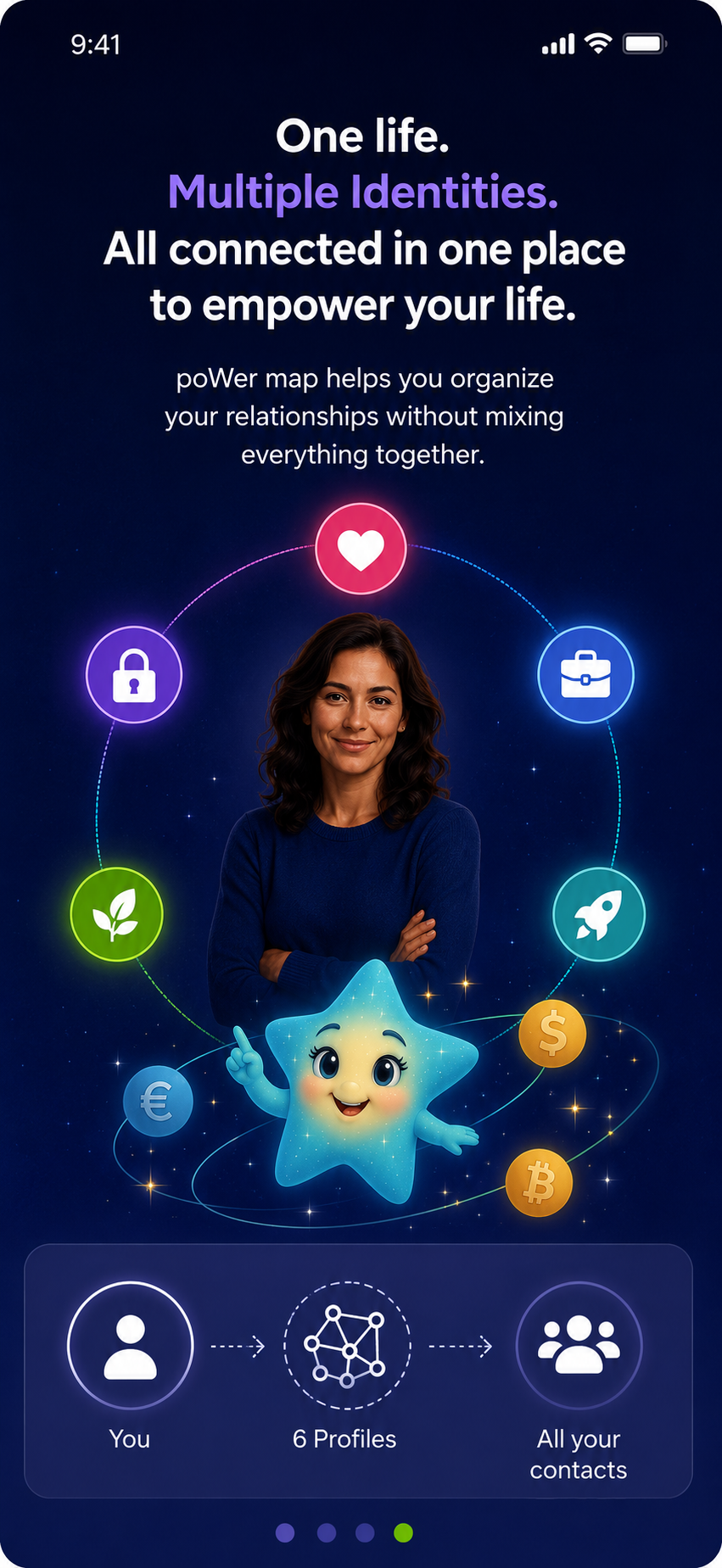
With our mobile app Power Map Contacts, organize your contacts, profiles, and identities in one app built for the multi-identity world.
Create personal, professional, or private profiles. Map your network. Take control of your personal brand.
A useful influence map should capture several dimensions.
What role does the person play in the situation?
Decision-maker.
Influencer.
Sponsor.
Blocker.
Evaluator.
User.
Advisor.
Connector.
Gatekeeper.
Budget owner.
Role matters because not every contact has the same impact on the outcome.
How much influence does this person have?
High influence.
Medium influence.
Low influence.
Unknown influence.
Influence is not always linked to seniority.
A junior technical expert can block a software decision.
An assistant can control access to an executive.
A respected internal manager can shape adoption.
A former colleague can create trust faster than a cold outreach campaign.
How strong is the relationship?
Strong relationship.
Warm relationship.
Weak relationship.
Dormant relationship.
No direct relationship.
This is one of the most important dimensions.
A highly influential person is useful only if there is a path to engage them.
Relationship strength helps identify where the network can actually be activated.
What is the person’s attitude toward the opportunity?
Supportive.
Neutral.
Skeptical.
Resistant.
Unknown.
This helps professionals avoid surprises.
A powerful supporter can accelerate momentum.
A quiet blocker can destroy a deal.
An undecided stakeholder can become the key to success.
Who can introduce whom?
Influence is often activated through trusted paths.
A cold message may fail.
A warm introduction may open the door.
An influence map should help identify the shortest and most credible path to the right person.
Why does this relationship matter?
Shared project.
Former company.
Mutual contact.
Past deal.
Common community.
Industry event.
Referral history.
Personal trust.
Context gives meaning to the relationship.
Without context, a map becomes a diagram.
With context, it becomes intelligence.
What should happen next?
Reconnect.
Ask for advice.
Request an introduction.
Share a relevant insight.
Prepare a meeting.
Address a concern.
Strengthen trust.
Invite to a conversation.
Document a risk.
An influence map should not only describe reality.
It should guide action.
The biggest mistake is confusing visibility with influence.
The most visible person is not always the most influential.
The loudest stakeholder is not always the most powerful.
The highest-ranking executive is not always the real decision-maker.
The friendliest contact is not always the best sponsor.
The person who attends every meeting is not always the person who controls the outcome.
Influence often hides in informal relationships.
That is why Power Map believes influence mapping must combine structure and human judgment.
Technology can help visualize the network.
But the user must still interpret the human dynamics.
Influence mapping can be powerful.
That means it must be used responsibly.
Mapping people should never become hidden manipulation.
The purpose of influence mapping should be to understand relationships, communicate better, reduce friction, build trust, and create value.
It should not be used to pressure people, exploit vulnerabilities, or reduce individuals to targets.
Ethical influence mapping requires several principles:
Collect only useful information.
Respect privacy.
Avoid sensitive profiling.
Keep context accurate.
Do not over-score people.
Use maps to improve relevance, not manipulation.
Protect relationship data carefully.
Keep human judgment at the center.
At Power Map, relationship intelligence is not about controlling people.
It is about understanding relationships with more clarity and respect.
Influence mapping is a key step toward relationship intelligence.
But relationship intelligence goes further.
It does not only ask who has influence.
It asks:
What is the history of trust?
What relationship context matters?
Which identity is involved?
What value can be created for both sides?
What is the right moment to reconnect?
What is the most respectful next action?
Which network is underused?
Which relationship carries hidden opportunity?
Which relationship should be protected?
This is the direction Power Map is building toward.
A world where contacts are not just stored.
They are understood.
A world where networks are not just collected.
They are mapped.
A world where opportunities are not only searched for.
They are discovered through relationships.
Power Map is designed to help professionals organize contacts, profiles, networks, and relationship context.
Instead of treating contacts as isolated records, Power Map helps users think in terms of relationships and opportunity networks.
With Power Map, users can start building influence maps by asking:
Who are the people connected to this opportunity?
Which profile or identity do they belong to?
How strong is my relationship with them?
Who can introduce me to whom?
What is the context of each relationship?
Which contacts are strategic?
Which relationships are dormant but valuable?
Which next action could create momentum?
This is valuable for individuals and teams.
A consultant can map client relationships.
A sales director can map buying committees.
A recruiter can map talent ecosystems.
A founder can map investors and advisors.
A solopreneur can map referral networks.
A fractional executive can map multiple companies and boards.
An enterprise team can map relationship capital across business units.
The more complex the professional ecosystem becomes, the more valuable influence mapping becomes.
Imagine a sales director trying to sell a platform to a large consulting firm.
The initial contact is a business development manager.
The business development manager likes the solution, but does not own the budget.
The Chief Revenue Officer owns the growth agenda.
The CFO controls the investment decision.
The CIO must validate security and integration.
A senior partner is skeptical because they fear consultant adoption will be low.
A former client of the sales director now works inside the firm and knows the senior partner.
A junior operations manager will be responsible for deployment and may influence the CIO’s opinion.
A traditional CRM would store these people as contacts in an account.
A pipeline tool would show the opportunity stage.
An influence map reveals the real system.
It shows that the business development manager is friendly but not powerful.
It shows that the CFO needs ROI evidence.
It shows that the CIO needs technical reassurance.
It shows that the senior partner is a potential blocker.
It shows that the former client can provide a trusted introduction.
It shows that the operations manager may be a hidden influencer.
Now the strategy becomes clearer.
The sales director should not only pitch the initial contact.
They should prepare the CFO business case, equip the friendly contact, address the senior partner’s concern, provide the CIO with technical material, and activate the former client as a credibility bridge.
That is influence mapping in action.
Influence mapping is not only for companies.
It can also help individuals manage careers.
Imagine a professional preparing a transition from corporate executive to independent consultant.
Their network includes:
Former clients.
Former colleagues.
Industry peers.
Recruiters.
Investors.
Startup founders.
Consulting partners.
Alumni communities.
Friends.
Mentors.
A simple contact list cannot show where the best opportunities may come from.
An influence map can reveal:
Who can introduce them to first clients.
Who has credibility in their target market.
Who knows consulting firms.
Who can validate their positioning.
Who can refer them to boards.
Who can create visibility.
Who should be reactivated first.
Which identity should be used in each conversation.
For career development, influence mapping turns a network into a strategic asset.
The modern professional world is becoming more complex.
Careers are less linear.
Organizations are more networked.
Buying committees are larger.
Work is more project-based.
Trust is more distributed.
Communities influence business.
Reputation travels faster.
Opportunities often appear through weak ties.
In this environment, professionals need better tools to understand their networks.
They cannot rely only on memory.
They cannot rely only on LinkedIn connections.
They cannot rely only on corporate CRMs.
They need personal relationship intelligence.
Influence maps are part of that future.
To build a useful influence map, start with a clear objective.
Do not map people for the sake of mapping people.
Map around a specific question:
How do we win this opportunity?
How do we enter this account?
How do we activate this network?
How do we prepare this project?
How do we find the right sponsor?
How do we grow this professional identity?
Then identify the relevant people.
Add their roles.
Assess influence carefully.
Document relationship strength.
Map connections between people.
Add context.
Identify supporters, skeptics, blockers, and unknowns.
Decide the next best action.
Review the map regularly.
An influence map is not a one-time diagram.
It is a living view of a relationship system.
Influence mapping is powerful because it reveals what titles and contact lists often hide.
It shows that influence is not only hierarchical.
It is relational.
It moves through trust, credibility, history, timing, and context.
For sales teams, influence maps reveal buying committees.
For consultants, they reveal client ecosystems.
For recruiters, they reveal talent networks.
For founders, they reveal investor paths.
For independent professionals, they reveal opportunity networks.
For enterprises, they reveal relationship capital.
Power Map’s vision is to make this intelligence easier to see, organize, and activate.
Because the future of professional success will not belong only to people with the largest contact lists.
It will belong to people who understand their relationships best.
Map the people. Understand the influence. Activate the opportunity.


